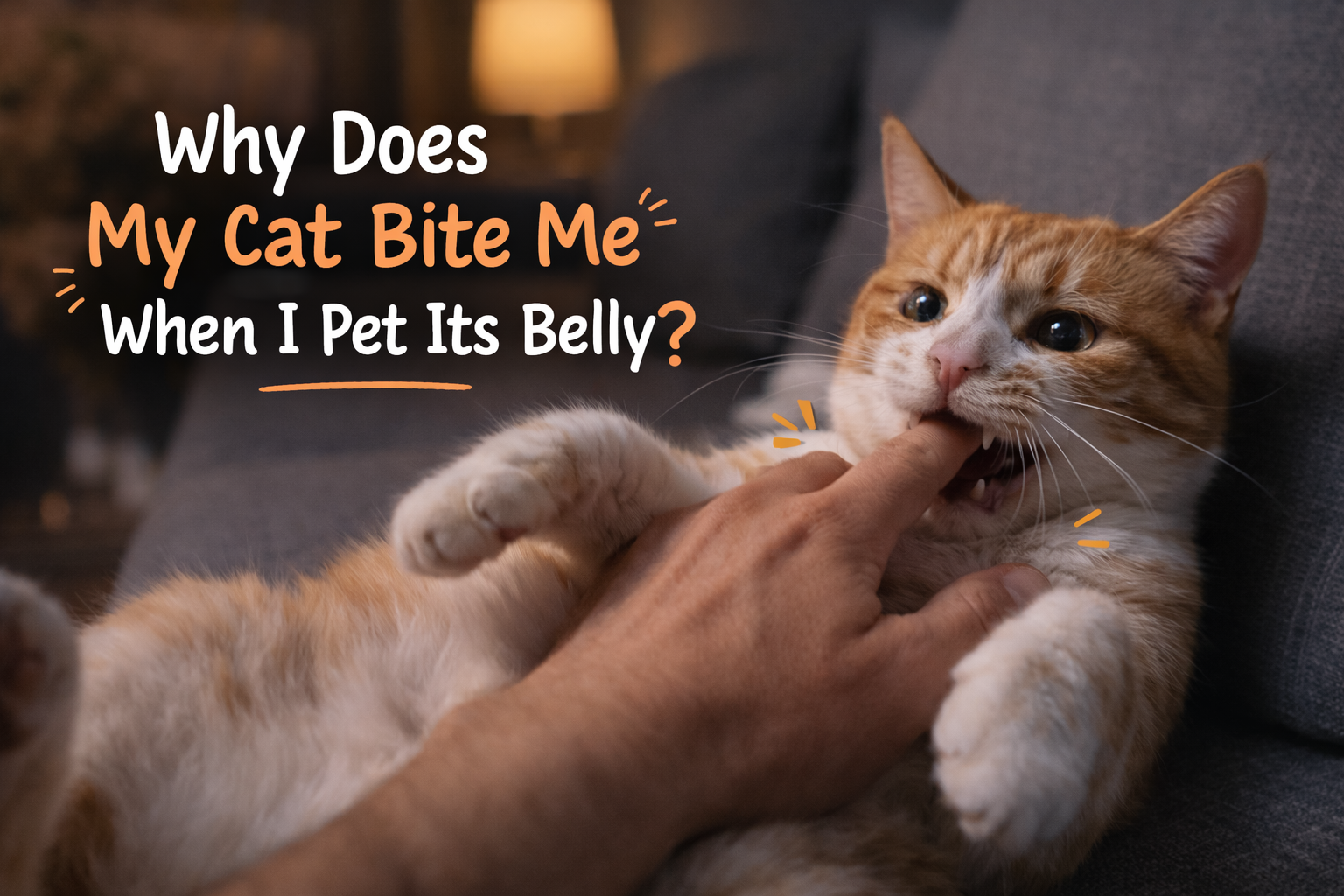
If you’ve ever tried to gently rub your cat’s soft belly only to get bitten seconds later, you’re not alone. This confusing behavior is one of the most common complaints among cat owners. One moment your cat seems relaxed—even inviting you in—and the next, you’re pulling your hand away in pain.
The truth is: your cat isn’t being “mean” or unpredictable. It’s communicating in the only way it knows how.
In this in-depth guide, you’ll learn why cats bite during belly rubs, what it really means, and how to respond properly without damaging your bond. If you want to go far, find here 6 important book for cats owners.
Understanding the Belly: A Sensitive and Vulnerable Area
A cat’s belly is not just another fluffy spot—it’s one of the most sensitive and vulnerable parts of its body.
In the wild, the stomach houses vital organs. Exposing it is a huge act of trust. That’s why when your cat rolls over, it doesn’t automatically mean “pet me here.” It often means:
- “I feel safe with you”
- Not necessarily “touch me”
According to experts, many cats instinctively protect this area, and touching it can trigger a defensive reaction—even if they trust you.
👉 Think of it like someone touching your most ticklish spot without warning. Your reaction wouldn’t be calm either.
1. Overstimulation: The #1 Reason Cats Bite
The most common explanation is something called petting-induced overstimulation.
At first, your cat enjoys the attention. It may purr, relax, and even encourage you. But after a few seconds or minutes, the sensation becomes too much.
This is because:
- Cats have highly sensitive nerve endings
- Repeated touch builds up sensory overload
- Their tolerance for petting is often short
When that threshold is crossed, your cat bites to say:
👉 “That’s enough.”
Experts confirm that overstimulation is one of the leading causes of sudden biting during petting sessions.
2. The Belly Is Not a “Petting Zone” for Most Cats
Unlike dogs, most cats do not naturally enjoy belly rubs.
While some cats tolerate it (and a few even love it), many see it as:
- Too sensitive
- Too vulnerable
- Too intense
Veterinary behavior insights show that cats typically prefer being touched on:
- The chin
- The cheeks
- The base of the ears
Not the stomach.
👉 So if your cat bites when you touch its belly, it may simply be saying: “Wrong spot.”
3. Miscommunication: Trust vs Invitation
Here’s where most cat owners get it wrong.
When a cat shows its belly, we assume it’s asking for affection. But in reality:
- It’s a sign of trust, not a request
- It means “I feel safe enough to be vulnerable”
If you misinterpret that signal and touch the belly, your cat may react defensively.
As one expert explanation puts it, the behavior is often a misunderstanding between human intention and feline communication. You want to know more about cats and take care efficiently, read these Books. If you purchase them, I will get a commission.
4. Play Aggression: Your Hand Becomes “Prey”
Sometimes, the bite isn’t defensive—it’s playful.
Cats are natural hunters. When you move your hand near their belly:
- It triggers hunting instincts
- Your hand becomes a “target”
- The cat grabs, kicks, and bites
This is especially common in:
- Kittens
- Cats raised playing with hands instead of toys
This behavior is called play aggression, and it mimics how cats hunt in the wild.
5. “Love Bites” vs Warning Bites
Not all bites are the same.
🟢 Love Bites (Gentle)
- Light nibbling
- Doesn’t break the skin
- Often during calm moments
These can be a form of affection or social grooming behavior.
🔴 Warning Bites (Stronger)
- Sudden and sharp
- Happens after signs of irritation
- Means “stop immediately”
Many experts explain that biting during petting is often a communication signal, not aggression.
6. You Missed the Warning Signs
Cats almost always warn before they bite—but their signals are subtle.
Common warning signs include:
- Tail flicking or whipping
- Ears turning sideways or flattening
- Skin twitching along the back
- Sudden muscle tension
- Dilated pupils
If these signals are ignored, the bite is the next step.
👉 In other words:
The bite isn’t sudden—you just didn’t see it coming.
7. Stress, Mood, or Health Issues
Sometimes, biting has nothing to do with your touch.
Your cat may be:
- Stressed
- Irritated
- Tired
- In pain
For example:
- An injured or sensitive area can make touch painful
- Changes in environment can increase irritability
Experts note that underlying discomfort or stress can make cats more likely to bite during interaction.
8. Every Cat Is Different
One important truth:
There is no “universal cat behavior.”
Some cats:
- Love belly rubs
- Never bite
- Enjoy long petting sessions
Others:
- Hate belly contact
- Get overstimulated quickly
- Prefer minimal touch
This depends on:
- Personality
- Early socialization
- Past experiences
What Reddit Cat Owners Say (Real Experiences)
From real cat owners:
“When I rub his belly, he grabs my hand and bites… but gently.”
“The belly is a no-touch zone… it’s a trap.”
These experiences highlight a key truth:
👉 Many cats don’t hate you—they just don’t like belly rubs.
What Should You Do Instead?
Now that you understand the reasons, here’s how to handle it properly.
1. Avoid the Belly (Unless Invited Repeatedly)
Stick to safe zones:
- Chin
- Head
- Behind ears
2. Learn Your Cat’s Limit
Stop petting before the bite happens.
Watch for early signs:
- Tail flick
- Body tension
3. Don’t Use Your Hands as Toys
If your cat bites during play:
- Use toys instead
- Redirect the behavior
4. Respect Boundaries
If your cat bites: 👉 Stop immediately
👉 Give space
Never punish your cat—it can increase fear and aggression.
5. Keep Sessions Short
Some cats only tolerate:
- 10–30 seconds of petting
That’s normal.
When Should You Be Concerned?
Occasional biting is normal. But you should pay attention if:
- Bites are frequent and aggressive
- Behavior suddenly changes
- Your cat seems in pain
In those cases, consult a veterinarian.
Final Thoughts
When your cat bites you during belly rubs, it’s not random—and it’s not betrayal.
It’s communication.
Your cat is telling you one of these things:
- “That’s too much”
- “Not there”
- “I’m playing”
- “I need space”
Once you understand these signals, everything changes.
Instead of getting bitten, you’ll start building a deeper, more respectful relationship with your cat—one based on understanding, not guesswork.
Key Takeaway
👉 A cat showing its belly means trust—not permission.
Respect that, and the bites will almost disappear.
➡️ Don’t forget these 6 Books for cats owners.






Leave a Reply