Introduction
Cats are famously mysterious creatures. Anyone who has shared a home with a cat knows that their behaviors can be both endearing and perplexing. From curling up in your laundry basket to staring at a seemingly empty corner for hours, cats communicate with their environment in ways that humans often struggle to understand. One fascinating question that has intrigued cat owners and animal behaviorists alike is: do cats associate specific rooms with emotional states? This post dives deep into the science, psychology, and practical implications of cat room-based emotional associations, all while exploring issues like how cats respond to different rooms, feline emotional behavior in the home, and understanding cat mood by location.
The Science Behind Cat Behavior and Emotions
Before we explore room-specific associations, it’s important to understand the basics of cat emotional behavior. Cats experience a range of emotions—stress, happiness, curiosity, fear, and affection. Unlike dogs, who are highly social animals, cats are more independent and territorial. Their emotional responses are often closely linked to environmental cues such as smells, sounds, and familiar spaces.
neuroscientists studying feline brains have found that cats have a highly developed limbic system, the part of the brain responsible for emotions. This system allows them to form memories associated with particular experiences, environments, and even people. So when a cat repeatedly experiences positive or negative events in a specific location, it can form emotional associations with that space.
Do Cats Form Emotional Attachments to Rooms?
Yes, cats can associate certain rooms or areas in your home with particular emotional states. This is largely due to a combination of conditioning, scent marking, and territorial instincts.
- Conditioning
Cats are creatures of habit. If your cat consistently eats in the kitchen, plays in the living room, or receives affection in a particular corner, it begins to connect those spaces with the emotions experienced during those activities. Over time, entering a room can trigger an emotional response before anything else happens. - Scent Marking
Cats rely heavily on their sense of smell to navigate the world. When a cat rubs its cheeks, paws, or body against furniture or walls, it deposits pheromones. These scent markers can convey messages to the cat itself and to others, such as “this space is safe” or “I’m feeling happy here.” A cat entering a room where it has positive pheromonal associations may feel comforted, while a room linked to stress may evoke caution or avoidance. - Territorial Instincts
Cats view their environment as a patchwork of territories. Each room can have its own “territory” significance, and emotions can be tied to how safe or familiar that territory feels. A cat may avoid a particular room where it previously encountered a stressful event, like a loud vacuum cleaner or an unfamiliar guest, demonstrating a learned emotional association.
Signs Your Cat Associates a Room With a Mood
Recognizing whether your cat links emotional states to rooms requires careful observation. Some behaviors to watch for include:
- Avoidance or reluctance: Cats may refuse to enter rooms associated with negative experiences. For example, a room where a cat was startled by loud noises may be avoided.
- Excited anticipation: Conversely, a cat may rush into a room associated with positive experiences, like feeding time or play sessions.
- Body language: Tail position, ear orientation, and pupil dilation can indicate emotional responses to different spaces.
- Vocalization: Some cats meow or purr in certain rooms, signaling comfort or distress depending on the context.
- Scent rubbing: A cat rubbing against furniture or walls often signals a positive emotional connection.
How Different Rooms Influence Cat Emotions
Not all rooms in a house hold the same significance for cats. Understanding how cats react emotionally to different areas can help owners create a more comfortable home environment.
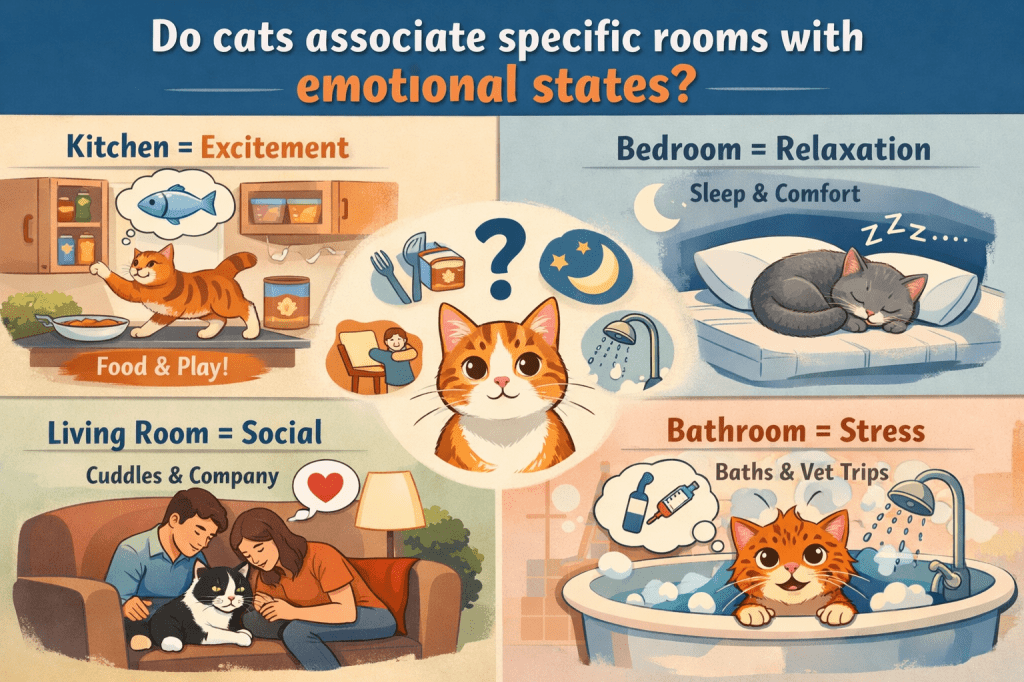
1. The Kitchen
Cats often associate the kitchen with food and treats. This connection can make the kitchen a source of excitement or even mild stress if meals are delayed. Some cats may sit near the pantry or fridge, anticipating food, displaying joyful behavior linked to the room.
Long-tail keyword opportunity: why cats get excited in the kitchen
2. The Living Room
The living room often doubles as a social and play area. Cats may associate this space with interaction, whether with humans or other pets. Positive experiences here can result in cats lounging comfortably, engaging in play, or seeking affection.
Long-tail keyword opportunity: cats and emotional attachment to living room spaces
3. Bedrooms
Bedrooms are frequently seen as safe havens. Cats may retreat to a bedroom to sleep, relax, or escape stressful situations. Emotional connections here are usually linked to security and calmness.
4. Bathrooms
Bathrooms often provoke curiosity or stress, depending on a cat’s experience. Running water, slippery surfaces, or confined spaces can create a mild stress response. Over time, cats may avoid bathrooms unless they have been positively reinforced.
How to Encourage Positive Emotional Associations in Different Rooms
Understanding your cat’s emotional landscape means you can actively create positive associations with specific rooms. Here are some tips:
- Positive Reinforcement
Introduce treats, toys, or affection in rooms you want your cat to enjoy. Consistent positive experiences can override negative memories. - Comfortable Retreats
Cats love enclosed spaces. Adding cozy beds, blankets, or cat trees to a room can enhance comfort and foster positive feelings. - Pheromone Diffusers
Synthetic feline pheromones, available in sprays or diffusers, can promote calmness in stressful areas, helping cats form new positive associations. - Gradual Exposure
If a cat is wary of a particular room, slowly increase exposure in a low-stress manner. For example, opening a door slightly or allowing the cat to explore for short periods can reduce anxiety.
Case Studies: Cats and Emotional Room Associations
Anecdotal evidence from cat owners and some behavioral studies provide insights:
- The anxious visitor scenario: A cat may avoid the living room when new people are present because of prior negative experiences. Over time, with positive reinforcement and gradual exposure, the cat may regain comfort in that space.
- Play area preference: Cats often choose a specific corner of the living room for play. Repetition and enjoyment in that spot strengthen emotional attachment to that location.
- Sleep sanctuaries: Bedrooms frequently become exclusive resting spots, associated with calm and security. Cats will often resist being moved from these emotionally safe zones.
The Role of Memory in Room-Based Emotional Associations
Cats possess excellent associative memory. This allows them to recall both positive and negative experiences connected to specific rooms. Unlike humans, whose memories are mostly verbal, a cat’s memory is sensory-driven: sight, smell, touch, and sound all combine to form strong emotional associations. This is why a cat may react differently to a room after a single stressful encounter or multiple positive experiences over time.
Practical Implications for Cat Owners
Understanding that cats may associate rooms with emotions has real-life implications for pet owners:
- Managing anxiety: Recognize which rooms trigger stress and use gradual desensitization or calming tools.
- Optimizing playtime: Place toys in rooms associated with positive emotions to encourage activity.
- Improving bonding: Spend quality time in spaces that the cat already finds comfortable.
- Adapting living spaces: Use comfortable, safe zones to mitigate behavioral issues stemming from room-based stress.
Conclusion: Every Room Tells a Story for Your Cat
Cats are not just passive observers of their environment; they actively map their emotional world onto the spaces they inhabit. A kitchen can be a place of excitement, a bedroom a sanctuary of calm, and a bathroom a source of cautious curiosity. By recognizing and respecting these room-based emotional associations, cat owners can foster a happier, healthier home for their feline companions.
The science of feline emotional behavior suggests that cats remember experiences and respond to environmental cues in complex ways. Understanding these subtle patterns enhances the human-cat bond and allows for a home environment that nurtures both emotional safety and joy for our furry friends
Why don’t you share this article with your friends, if you find it useful ? 🙏🙏




 Fresh Cat News: Trusted Updates for Cat Lovers & Responsible Owners
Do you found this guide useful, please leave a comment.