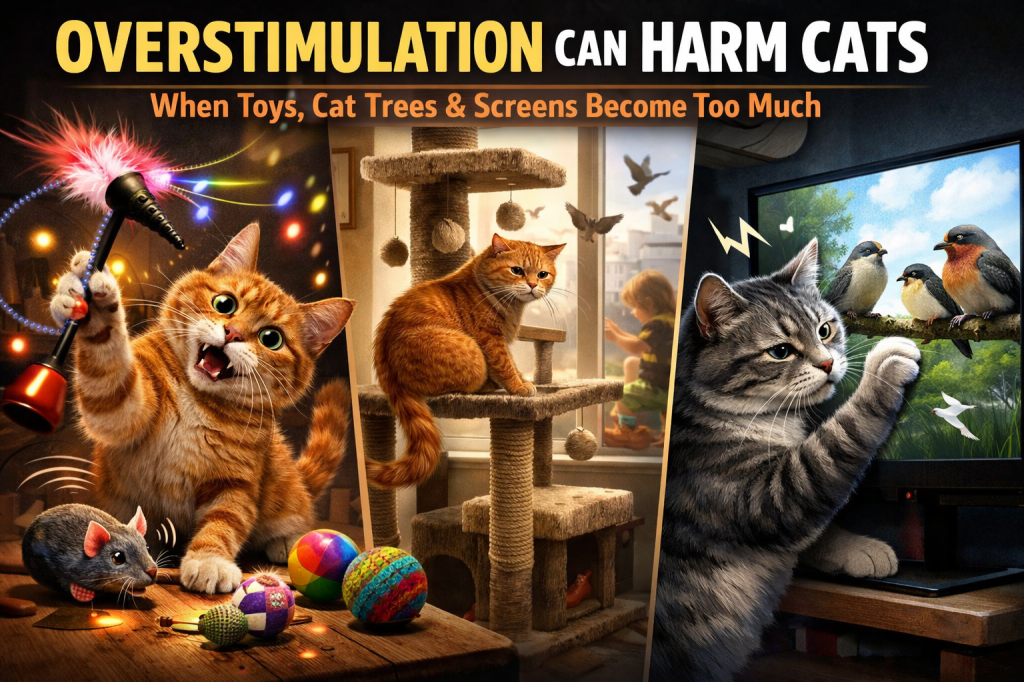
For years, cat owners have been encouraged to stimulate their cats as much as possible. More toys. Taller cat trees. Endless videos of birds and mice on screens. Smart gadgets that promise to keep cats busy while humans are away.
But an uncomfortable question is finally emerging in feline behavior, science and veterinary discussions:
Can too much stimulation harm a cat ?
The answer is increasingly clear: yes.
While cats need mental and physical enrichment, overstimulation is real, and it can negatively affect a cat’s emotional balance, behavior, and even physical health. Just like humans, cats have limits. When those limits are crossed, the result is often stress disguised as excitement.
This article explores:
- What overstimulation really means for cats
- How toys, cat trees, and screens can become harmful
- The warning signs many owners overlook
- How to create healthy, species-appropriate enrichment
Understanding the Cat’s Natural Stimulation Needs.
To understand overstimulation, we must first understand how cats evolved.
Domestic cats are descended from Felis lybica, a solitary, ambush predator. Unlike dogs, cats are not endurance hunters. They are designed for:
- Minimal sensory overload
- Long periods of rest
- Short bursts of intense activity
In nature, a cat may hunt 2–6 times per day, with hours of inactivity in between. There are no flashing lights, repetitive noises, or constant movement.
According to the International Cat Care organization, cats thrive on predictability and control, not constant excitement.
https://icatcare.org
Modern indoor environments, however, often do the opposite.
What Is Overstimulation in Cats?
Overstimulation occurs when a cat is exposed to more sensory input than it can comfortably process, over time or too intensely.
This may include:
- Constant opportunities to “hunt” without resolution
- Excessive visual motion
- Repetitive sound
- Continuous novelty with no rest periods
Unlike boredom, overstimulation does not calm down a cat. It keeps the nervous system in a heightened state, similar to chronic stress.
Veterinary behaviorists now recognize overstimulation as a trigger for anxiety-related behaviors, aggression, compulsive actions, and emotional withdrawal.
Too Many Toys: When Play Becomes Pressure
The Myth: “More Toys = Happier Cat”
Pet stores and online shops promote the idea that cats need dozens of toys available at all times. Interactive toys spin, chirp, flash, and move automatically.
But cats don’t play like humans expect them to.
In nature:
- Rest follows effort
- hunt has a beginning, middle, and end
- Success matters
When toys are always available, moving and unpredictable, The cat’s brain never completes the hunting cycle.
The Consequences of Toy Overload.
Overstimulated cats may:
- Become frustrated or aggressive
- Zoom excessively and crash into objects
- Attack hands or feet suddenly
- Bite during petting
According to Cornell University’s College of Veterinary Medicine, play that lacks structure or resolution can increase arousal without satisfaction, leading to behavioral problems.
https://www.vet.cornell.edu
Healthier Toy Practices
- Avoid noisy or flashing toys unless your cat clearly enjoys them
- End play with a treat or meal to complete the hunt cycle
- Use short, intentional play sessions (5–15 minutes)
- Rotate toys weekly instead of leaving all out
Cat Trees: Vertical Space or Sensory Overload?
Cat trees are often recommended as essential enrichment—and they can be beneficial. Vertical space allows cats to:
- Rest above ground
- Feel in control
- Observe safely
However, problems arise when cat trees are:
- Placed in high-traffic or noisy areas
- Combined with constant external stimuli
- Overly complex
When Cat Trees Increase Stress
tall tree placed near:
- A child’s play area
- A busy window
- A television
can expose the cat to continuous stimulation without escape.
Cats need safe vantage points, not permanent watchtowers.
The American Association of Feline Practitioners emphasizes that enrichment must include retreat options, not just activity.
https://catvets.com
Signs the Cat Tree Is Too Much
- Increased reactivity after spending time there
- The cat sleeps elsewhere despite having access
- The cat paces or vocalizes while on it
- The cat avoids it completely
Screens for Cats: Entertainment or Mental Trap?
One of the fastest-growing trends in pet content is videos designed specifically for cats: birds, fish, squirrels, mice.
While these videos seem harmless—and sometimes adorable—they pose unique risks.
Why Screens Can Be Overstimulating
Screens present:
- No sensory closure
- No successful capture
- Endless prey with no physical interaction
This creates a state called frustrated predation.
According to veterinary behaviorist Dr. Mikel Delgado, repeated exposure to unattainable prey can increase anxiety and compulsive behaviors in some cats.
https://indoorpet.osu.edu
Warning Signs After Screen Exposure
- Restlessness after the video ends
- Sudden aggression toward humans or other pets
- Pawing at the screen repeatedly
- Chattering followed by agitation
Screens are especially risky for:
- Cats prone to redirected aggression
- Anxious cats
- High-energy cats
Safer alternatives :
- Avoid daily use
- Never leave videos playing unattended
- Pair screen time with physical play afterward
- Use screens briefly (5–10 minutes max)
Behavioral Problems Linked to Overstimulation
Many common “bad behaviors” are actually stress responses.
These include:
- Withdrawal and hiding
- Nighttime hyperactivity
- Litter box avoidance
- Excessive grooming or hair loss
- Sudden biting during petting
The ASPCA notes that environmental stress is one of the most underestimated causes of feline behavioral issues.
https://www.aspca.org
Why Humans Overstimulate Cats (Without Realizing It)
Most overstimulation is not intentional. It comes from:
- Fear of boredom
- Anthropomorphism (treating cats like children)
- Marketing pressure
- Human guilt about indoor living
But cats are not humans. They do not need constant entertainment. They need security, predictability, and rest.
How to Create a Calm, Cat-Centered Environment
1.Reduce Visual Noise
- Use curtains if outdoor movement causes stress
- Avoid placing beds near TVs
- Limit screen exposure
2.Schedule Play
- End with food or treats
- Same times daily
- 1–3 intentional sessions per day
Each cat has different tolerance levels. What excites one cat may overwhelm another so observe and don’t assume.
The Role of Silence and Stillness
One of the most overlooked forms of enrichment is peace.
Cats benefit from:quiet rooms, predictable routines and minimal interruptions.
As Jackson Galaxy often emphasizes, cats need confidence before stimulation, not the other way around.
https://www.jacksongalaxy.com
Conclusion: Less Can Be More
Modern cat ownership often equates love with activity. But for cats, rest is a biological necessity.
Overstimulation doesn’t always look dramatic.
By reducing excess toys, limiting screens, and respecting your cat’s sensory limits, you create something far more valuable than entertainment:
You Loved this article please share it or leave a comment.


 Fresh Cat News: Trusted Updates for Cat Lovers & Responsible Owners
Do you found this guide useful, please leave a comment.