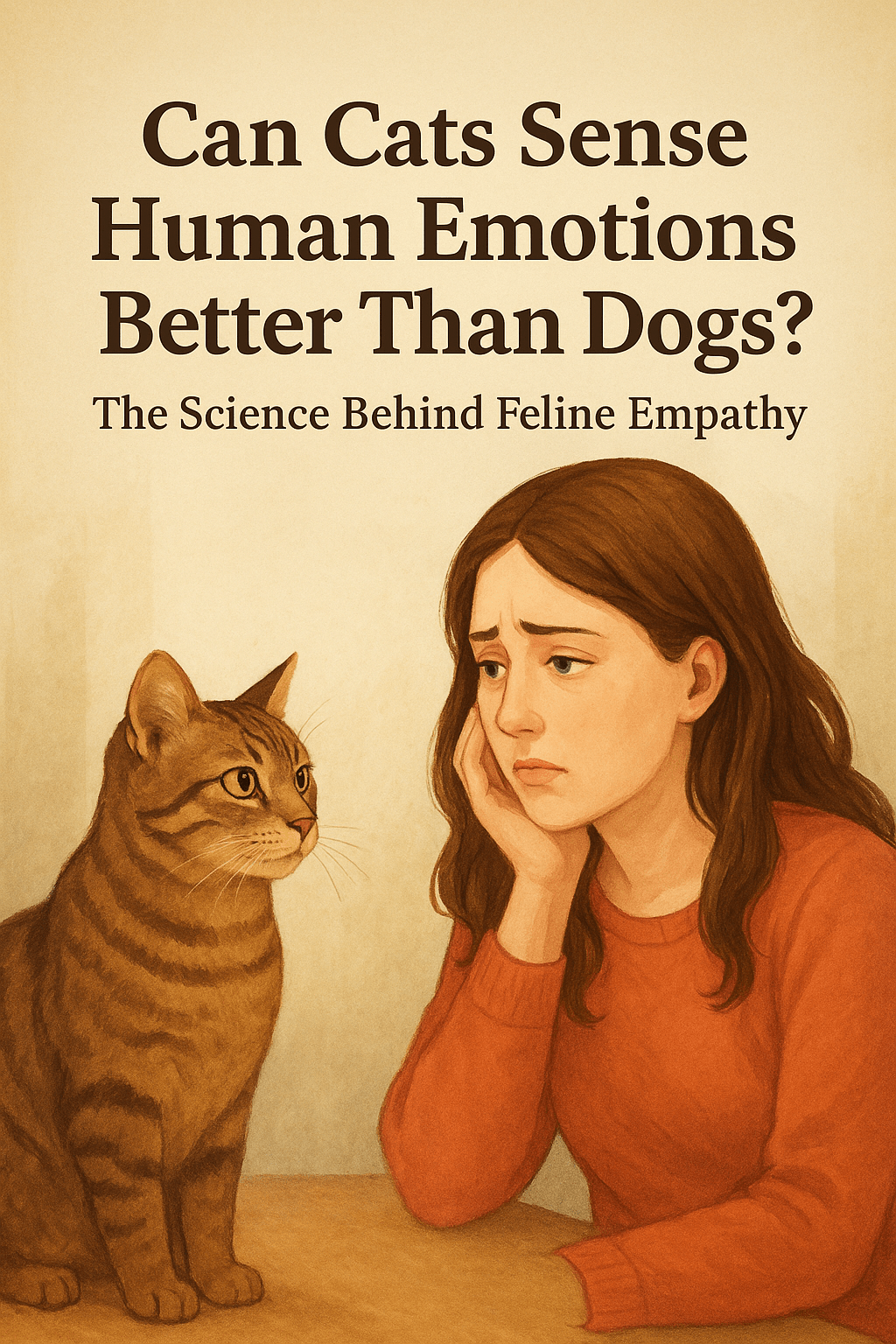
Discover whether cats can truly sense human emotions better than dogs. Learn about feline empathy, behavior studies, and how cats respond to sadness, stress, and happiness.
Introduction: The Emotional Bond Between Humans and Cats
Humans have long shared a deep connection with their pets, but the question remains: can cats sense human emotions better than dogs?
While dogs are famous for their loyalty and intuitive empathy, cats often carry a reputation for being aloof or independent. However, growing scientific research is challenging this stereotype.
Cats may not wag their tails or jump into your lap every time you cry, but their subtle sensitivity to human emotions might surprise you. Recent studies reveal that cats can read facial expressions, tone of voice, and even body language — sometimes more accurately than dogs.
Let’s explore how cats perceive our emotional states, what science says, and how they might quietly comfort us when we need it most.
1. The Science of Emotional Sensitivity in Cats
Contrary to the myth of feline indifference, cats are emotionally attuned creatures. In 2020, researchers from the University of Lincoln found that cats can recognize both positive and negative human emotions by observing facial cues and voice tones.
Cats are highly observant animals, relying less on direct cues (like scent or touch) and more on context and body language. They often pick up emotional energy through changes in:
- Tone of voice
- Body posture
- Breathing rhythm
- Facial expression
- Routine disruptions
For instance, when you speak softly or smile, your cat may approach or purr, sensing calmness. But if you raise your voice or move abruptly, they may retreat — interpreting it as anger or stress.
👉 : Scientific American: How Cats Read Human Emotions
2. How Cats React to Human Sadness and Stress
Many cat owners can recall a moment when their feline friend climbed onto their lap during a tough day or quietly stayed nearby when they cried.
Studies have shown that cats display empathetic behaviors — though subtly — such as:
- Sitting close or making contact when their owner is distressed.
- Mirroring emotions — appearing calm when you’re calm, or hiding when you’re upset.
- Adjusting vocalizations — some cats meow softly or rub against you during emotional moments.
A study published in Animal Cognition (2019) observed that cats approach their owners more frequently when they hear a “distressed” tone versus a neutral one. This implies that cats not only recognize emotions but respond intentionally to them.
“Cats are emotionally intelligent in their own quiet way — they comfort without smothering.”
— Dr. Deborah Wells, Animal Behaviorist
3. Dogs vs. Cats: Who Understands Humans Better?
Dogs have co-evolved with humans for around 30,000 years — compared to cats’ 10,000-year history of domestication. Dogs have been bred specifically for companionship and emotional bonding, which gives them an edge in reading and responding to human emotions.
However, recent studies suggest that cats may surpass dogs in perceptive subtlety. Where dogs rely heavily on explicit emotional cues (tone, command, expression), cats seem to interpret the underlying energy and atmosphere of human emotions.
🐶 Dogs: The Extroverted Empaths
- React visibly to tears and stress.
- Seek physical contact and reassurance.
- Often mirror human excitement and energy.
🐱 Cats: The Introverted Observers
- Respond quietly but intentionally.
- Offer proximity, purring, or stillness instead of overt affection.
- Sensitive to subtle changes in human behavior and routines.
So, while dogs express empathy more openly, cats may sense emotions more intuitively — particularly when those emotions are subtle or mixed.
👉 : Psychology Today: How Dogs and Cats Differ in Emotional Intelligence
4. The Role of Scent and Energy in Feline Perception
Cats possess around 200 million scent receptors — far fewer than dogs, but still powerful enough to detect chemical changes in human sweat or pheromones related to stress or sadness.
When you’re anxious, your body releases cortisol, and your scent slightly changes. Cats, being highly scent-aware, may pick up on this and adjust their behavior — becoming more watchful, hiding, or even staying close to “guard” you.
Beyond scent, some researchers believe cats respond to energetic cues — the invisible signals of emotion humans give off through body tension, heart rate, and breathing patterns. Cats, being both prey and predator species, evolved to sense these subtle shifts for survival.
This may explain why cats often come near calm people and avoid those who seem agitated.
5. The Power of Purring: A Healing Response
When cats sense emotional or physical pain in their owners, they often purr — not just as a sign of comfort, but potentially to heal.
The frequency of a cat’s purr (between 25 and 150 Hz) has been shown to stimulate tissue regeneration, reduce stress, and lower blood pressure — both for the cat and its owner.
So, when your cat purrs next to you while you’re sad or sick, it’s not only affection; it might be a natural therapeutic response.
👉 : BBC Future: The Science Behind a Cat’s Purr
6. Why Cats Show Their Empathy Differently
Cats express emotion through actions, not words — and often, their version of “comfort” looks like quiet companionship rather than overt attention.
Here are common ways cats show empathy or emotional understanding:
- Slow blinking — a sign of trust and connection.
- Head-butting or cheek rubbing — marking you as part of their social group.
- Following you around — silent emotional support.
- Sleeping near you — sharing warmth and safety.
- Mirroring moods — being calm when you are, restless when you’re anxious.
Feline empathy may be less obvious than a dog’s tail wag, but it’s equally meaningful. Cats are attuned to your rhythms — the pace of your steps, your tone of voice, and your energy level — and adapt themselves accordingly.
7. When Cats Misinterpret Human Emotions
Because cats rely heavily on routine and sensory cues, sudden emotional outbursts can confuse or frighten them.
For instance, yelling or crying loudly might be perceived as danger rather than sadness.
To help your cat understand and feel safe:
- Maintain calm tones even when upset.
- Avoid abrupt movements.
- Allow your cat to choose when to comfort you.
- Reward them gently when they approach during emotional moments.
Over time, your cat will learn that your emotions aren’t threats — but signals of closeness and trust.
8. Can Cats Help Improve Human Mental Health?
Absolutely. Numerous studies confirm that living with a cat reduces anxiety, loneliness, and depression. Their quiet companionship and rhythmic purring create a sense of calm and presence.
Unlike dogs, cats do not demand constant attention, making them ideal for introverts or people struggling with mental health who need companionship without pressure.
Owning a cat has been linked to:
- Lower stress hormone levels
- Reduced blood pressure
- Improved emotional resilience
- Enhanced sense of purpose
It’s not surprising that therapy cats are now being used in hospitals, nursing homes, and trauma recovery programs.
9. The Verdict: Do Cats Sense Human Emotions Better Than Dogs?
So, can cats sense human emotions better than dogs?
The answer depends on what we mean by “better.”
- Dogs excel at reacting visibly — offering direct emotional support and reading overt cues.
- Cats excel at sensing subtle emotional states — quietly mirroring, adapting, and comforting without being intrusive.
In essence, dogs respond, while cats resonate.
Your cat might not lick away your tears, but it may curl up beside you, sensing your emotional need — and that, too, is love in its own feline language.
10. How to Deepen Your Emotional Connection with Your Cat
To strengthen this mutual understanding:
- Maintain eye contact and blink slowly.
- Speak softly and consistently.
- Establish a predictable routine.
- Respect their space.
- Reward emotional moments (purring near you, staying close).
With time, your cat will not only recognize your moods but become an emotional companion who provides comfort when you need it most.
🐾 Conclusion: The Silent Empathy of Cats
While dogs might win the title for expressive empathy, cats possess a quiet, profound sensitivity to human emotions that’s easy to underestimate. They may not always show affection in ways we expect, but they feel and reflect our emotions deeply — often without words or actions.
When your cat curls beside you during a rough day or gazes into your eyes with slow blinks, that’s empathy — feline style.
If you’ve ever wondered whether your cat understands you — the answer is yes, probably more than you think.
Spend time observing their reactions, reward their affection, and let them share your emotional world.
Want to learn more about feline psychology and care?
👉 Explore the American Association of Feline Practitioners’ Cat Behavior Resources for expert insights and don’t forget to share it with a friend.






 Fresh Cat News: Trusted Updates for Cat Lovers & Responsible Owners
Do you found this guide useful, please leave a comment.