Introduction
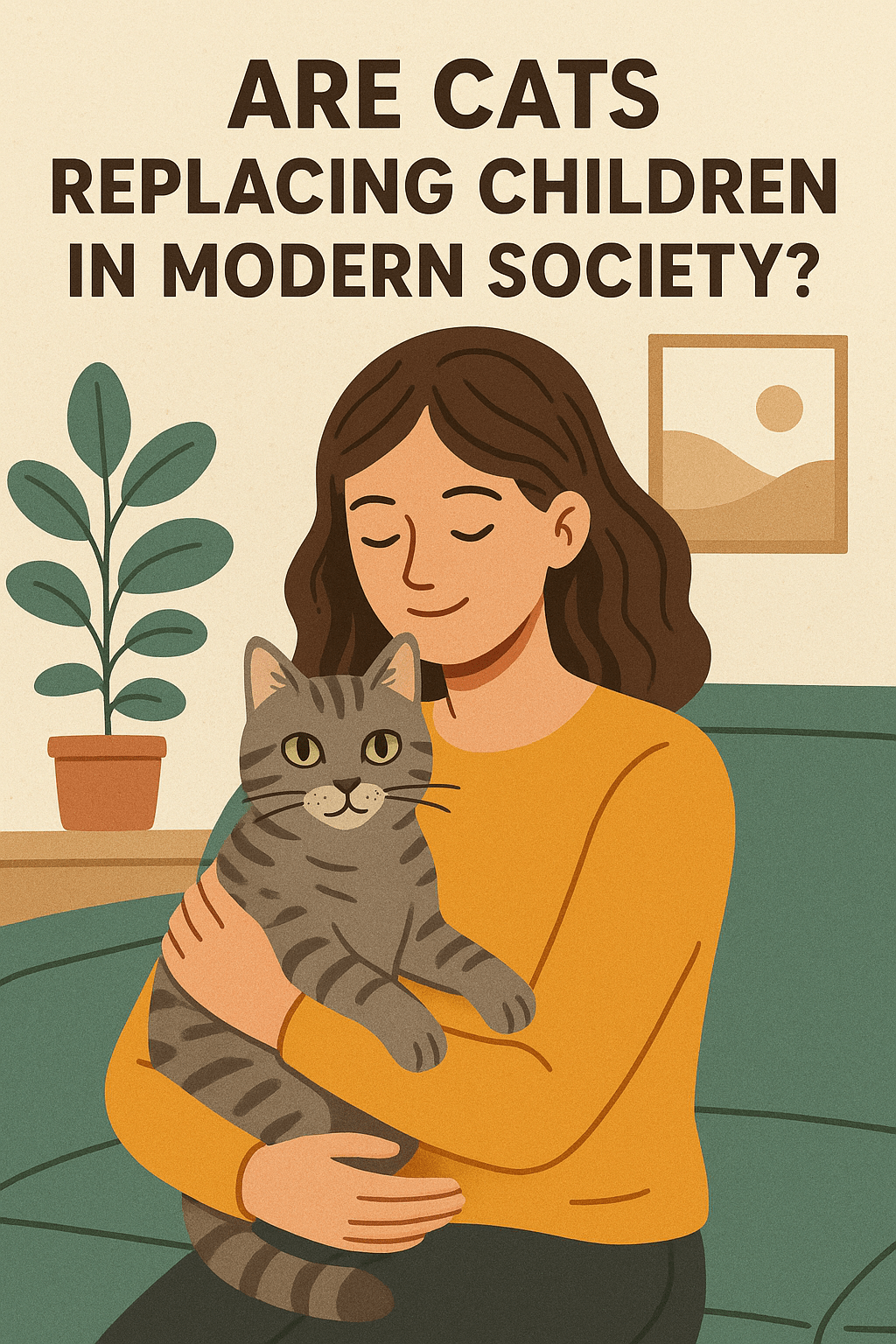
In recent years, an undeniable social shift has occurred: many young adults are choosing cats over children. Across cities from New York to Tokyo, millennials and Gen Zers are redefining family life with furry companions instead of babies. This growing trend raises a fascinating question — are cats actually replacing children in modern society?
While this might sound exaggerated, data and social behaviors tell a compelling story. Let’s explore why this is happening, what it means for society, and how our feline friends have found a new role as “fur babies” in the modern world.
1. The Rise of the “Pet-Parent” Generation
Traditionally, pets were kept for companionship or practical reasons, like hunting mice or guarding homes. But in the 21st century, the relationship between humans and animals has transformed dramatically.
The term “pet owner” is quickly being replaced by “pet parent.” Cat lovers now describe themselves as “moms” and “dads” to their felines, celebrating birthdays, buying gifts, and even creating Instagram accounts for them.
According to Forbes Pet Statistics 2024, 66% of U.S. households own a pet — an all-time high. Younger generations are leading this trend, with millennials making up nearly 33% of pet owners. Cats, in particular, fit perfectly into the lifestyle of modern urban dwellers: they’re independent, low-maintenance, and apartment-friendly.
This cultural shift reflects more than affection for animals; it’s part of a deeper redefinition of family and emotional connection.
2. Economic Pressures and Lifestyle Choices
Raising a child is expensive — very expensive. In many developed countries, the cost of raising one child can exceed $250,000 before college. Add inflation, housing prices, and unstable job markets, and it’s no surprise that many young adults are hesitant to take on that responsibility.
Cats, on the other hand, offer unconditional love at a fraction of the cost. Between food, litter, and vet visits, annual expenses for a cat typically range from $800 to $1,200. That’s still an investment, but one that feels manageable compared to daycare fees and university tuition.
Additionally, the modern lifestyle values flexibility and freedom. Cats fit neatly into this rhythm:
- They can stay alone during work hours.
- They don’t require daily walks.
- They adapt well to smaller living spaces.
For people focusing on careers, travel, or self-discovery, adopting a cat can satisfy emotional needs without compromising independence.
3. Emotional Fulfillment Without Traditional Parenthood
One of the biggest drivers of the “cats over kids” trend is emotional. Many individuals and couples feel a deep bond with their cats, often describing them as “soul companions.” Cats offer affection, loyalty, and comfort — qualities traditionally associated with raising children.
In a fast-paced, uncertain world, cats provide stability and connection. Studies have shown that interacting with pets can reduce stress, anxiety, and loneliness. The Human Animal Bond Research Institute reports that 85% of pet owners believe their pets help them deal with stress.
For people who choose not to have children — temporarily or permanently — cats fulfill nurturing instincts in a manageable, mutually rewarding way. Social media is filled with evidence of this emotional substitution: from “cat moms” sharing family-style portraits to cat cafés where visitors seek emotional relief.
4. Changing Social Norms and the Redefinition of Family
The concept of “family” has evolved beyond the traditional nuclear model. Society now embraces a wider spectrum — single-person households, same-sex couples, child-free lifestyles, and pet-inclusive families.
In many urban areas, it’s common to see cats featured in family Christmas cards or even listed as household members in apartment applications. Sociologists refer to this as the “post-traditional family,” where emotional bonds, not biology, define family life.
This change isn’t just cultural — it’s also demographic. Birth rates are declining globally. Countries like Japan, Italy, and South Korea have reached record-low fertility rates, while pet ownership continues to soar.
In other words, cats aren’t just replacing children symbolically — they’re filling real emotional and social spaces left by delayed or declined parenthood.
5. The Role of Technology and Social Media
Technology has amplified our affection for cats and normalized the idea of pet parenthood. Platforms like Instagram, TikTok, and YouTube are filled with feline influencers whose lives mirror those of human children.
Famous cats like Nala Cat, Grumpy Cat, and Cole and Marmalade have millions of followers, sponsorships, and even merchandise. This digital exposure reinforces the emotional bond between humans and their pets, while also shaping cultural expectations around care, humor, and companionship.
Social media has turned cat ownership into a lifestyle statement — part of one’s identity, much like being a parent or a traveler. It celebrates the joy of caregiving without the long-term pressures of raising a child.
6. Ethical and Environmental Considerations
Interestingly, some people choose cats over children for ethical or ecological reasons. Climate-conscious individuals worry about the environmental footprint of human reproduction. Choosing to remain child-free is seen by some as a responsible way to reduce resource consumption and carbon emissions.
Cats, by contrast, are viewed as companions that align with sustainable, minimalist living — though it’s worth noting that pet food production also has an environmental impact.
This perspective doesn’t come from selfishness, but from a re-evaluation of personal values in a world facing overpopulation and ecological crisis. Caring for cats can thus become a way to express empathy and responsibility in a gentler form.
7. The Psychological Dimension: Control and Predictability
Parenting is unpredictable and lifelong. Raising children involves risk, uncertainty, and emotional vulnerability. Cats, on the other hand, offer affection with clearer boundaries. Their needs are tangible, their behavior (mostly) predictable, and their love unconditional when nurtured properly.
This sense of control appeals to individuals living in an increasingly unstable world — economically, politically, and emotionally. Cats give people the comfort of caring for another being without the existential weight of parenthood.
8. Are Cats Truly Replacing Children?
While it’s true that many young adults treat cats as family, calling it a “replacement” might oversimplify a broader cultural evolution. It’s not necessarily about choosing cats instead of children — it’s about redefining what fulfillment and family mean in the 21st century.
Cats symbolize independence, emotional balance, and unconditional love — all qualities that resonate with modern values. They are companions for those who prioritize mental health, flexibility, and self-expression.
In essence, cats aren’t replacing children. They’re helping humans reinvent the idea of nurturing in a world that demands new forms of connection.
Conclusion: The Future of “Fur Families”
The rise of “fur babies” marks a significant transformation in modern society. Economic challenges, emotional needs, environmental awareness, and changing cultural values all play a role in making cats central to our concept of family.
As we move further into an era where individuality and emotional wellness guide life choices, cats may continue to thrive as symbols of affection, balance, and freedom.
So, are cats replacing children? Perhaps not literally — but they are certainly redefining what it means to love, nurture, and build a family in today’s world.
External Links for Further Reading:



 Fresh Cat News: Trusted Updates for Cat Lovers & Responsible Owners
Do you found this guide useful, please leave a comment.