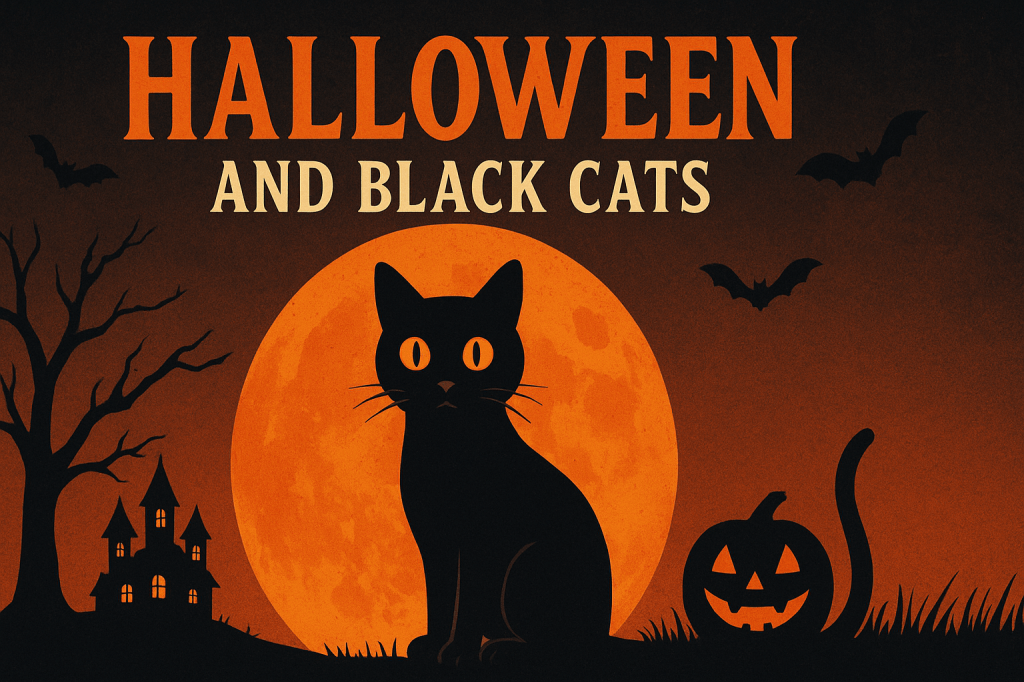
Discover how the sleek black cat became an enduring symbol of Halloween — from ancient reverence to medieval fear, to modern décor — and how its story still affects us today.
Introduction
When you think of Halloween, what pops into your mind? Pumpkins carved with grinning faces, ghosts floating in windows, witches riding broom-sticks — and, almost inevitably, a black cat perched in silhouette by a lit candle or perched in a haunted‐house window. The image of the black cats at Halloween is so familiar that we barely stop to ask: Why? How did the black cat become such a powerful Halloween symbol?
In this article we’ll trace the journey of the black cat across centuries and cultures: how it went from being sacred, to sinister, to decorative — and how that legacy still lingers in how we treat black cats today.
1. Black Cats in the Ancient World: Reverence and Mystery
Ancient Egypt
One of the earliest and most positive associations of cats — including black‐coated ones — is found in ancient Egypt. The goddess Bastet (sometimes Bast) was depicted as either a lioness or a woman with a cat’s head, and she came to embody protection, home, fertility and the domestic cat. Some sources note that black cats (though not exclusively) were honoured in Egyptian society.
In such a context, the cat was not an ominous creature but a sacred one — and this sets a starting point in our story: black cats were once revered, admired, and protected.
Early Symbolic Meanings
Because black fur stands out at night (or vanishes into night), it may have contributed to the aura of mystery surrounding black cats. The interplay of darkness, night‐prowling, and the feline’s silent steps helped feed legends of magic, guardianship and spiritual power.
Thus the black cat already carried symbolic weight even before the Halloween tradition emerged.
2. The Middle Ages and the Rise of Superstition
Black Cats, Witches, and the Church
By the 13th century in Europe, the status of the black cat changed dramatically. A key turning point was the papal bull Vox in Rama issued by Pope Gregory IX in 1233, which declared that black cats were incarnations of Satan.
The Christian Church, in its struggle with paganism, witchcraft and competing spiritual practices, began to cast cats — especially black ones — as symbols of evil and demonology. According to folklore, black cats were familiars of witches, or even witches in animal form.
As a result, black cats became associated with night, danger, betrayal, witchcraft and the supernatural.
The Plague and Cat Persecution
An especially grim chapter: in Europe during the plague eras, cats (including black cats) were often killed along with alleged witches and familiar spirits. The logic was flawed (killing cats removed rodent predators) but superstition ruled.
Thus the black cat’s image became clouded: once a sacred creature, now an ominous one.
3. The Celtic Roots of Halloween, and How the Black Cat Joined In
The Festival of Samhain
The ancient Celtic festival of Samhain (around 31 October) marked the transition from harvest to winter, the thinning of the veil between the living and the dead, and the time when spirits roamed.
Because this was a liminal time — when darkness lengthened, shadows grew, and nocturnal creatures prowled — black animals and nighttime predators were often tied to spiritual fear. In this way, cats (especially black) became part of the broader imagery of Halloween.
From Pagan to Christian to Popular
As Christian traditions merged with Celtic harvest festivals, the symbolism around black cats, shadows and witches converged. The black cat became one of the visual shorthand elements of Halloween: dark, mysterious, silent, maybe sinister.
One account points out that black cats were often seen around bonfires and dark gatherings during Samhain-type celebrations, feeding into their association with the supernatural.
Thus by the late medieval period, the black cat was firmly embedded in the pre‐modern foundation of Halloween symbolism — long before Halloween as we know it emerged.
4. Black Cats in Early Modern Europe and Colonial America
Europe: Witch Hunts and Folklore
In 16th–17th century Europe, the witch hunts were in full swing; black cats were implicated as witches’ companions, familiars, or shape‐shifters. This reinforced negative stereotypes that persist. The idea that a black cat crossing your path brings bad luck became deeply rooted.
Also, animals that did not “behave” like domesticated dogs — cats being independent, nocturnal, inscrutable — were easily projected upon as suspicious. The black cat, silent in the night, became a perfect candidate for myth.
Colonial America
When European settlers came to North America, they brought these beliefs. In Puritan New England especially, a strict religious ethos and fear of the unknown combined with black-cat superstitions. A black cat could be seen as a sign of witchcraft or misfortune.
Over time, as Halloween became more secular and commercial, the black cat image persisted — now more decorative, but still weighted with legacy.
5. The Black Cat as Halloween Icon (19th to 20th centuries)
Rise of Halloween Imagery
By the 19th and early 20th centuries in the United States and Britain, Halloween began to take on many of the features we know today: costumes, parties, decorations, jack-o’-lanterns, ghosts and black cats. One source notes that black cats featured on postcards, greeting cards and in magazine covers from the late 1800s, helping cement their place in popular culture.
The black cat had become part of the Halloween “cast” of characters: witches, skeletons, bats — and the black cat, perched ominously.
Commercialisation and Stereotype
With the growth of printed imagery and holiday‐marketing, the black cat became a motif used to signify “spooky,” “autumn,” “mystery.” But the underlying superstitions were still present — for example, that black cats might bring misfortune, or were linked to the supernatural. A 2021 article reminds us the belief of a black cat crossing your path as bad luck traces back centuries.
Meanwhile, the black cat image was widely used on Halloween merchandise, decorations and greeting cards, reinforcing the stereotype more by aesthetic than by myth.
6. Black Cats in Culture & Folklore Around the World
While the Western story is one of suspicion and fear, black cats do not universally mean bad luck everywhere.
Positive Associations
- In Japan, black cats are sometimes considered good luck — especially to single women and business owners.
- In some parts of Scotland and French Canada, black cats were once seen as protective or lucky.
The Cultural Contrast
The variation shows us that the black cat’s meaning is not inherent — it is culturally constructed. In religious, folklore, mythic contexts, the same creature can be revered or reviled.
7. Why the Black Cat Symbol Still Matters at Halloween
Why Are We Still Using It?
There are several reasons the black cat remains central to Halloween:
- It visually represents night, shadow, mystery and the unknown — all themes of Halloween.
- It links to witchcraft lore and supernatural motifs that are part of Halloween’s popular image.
- It has a historical baggage of superstition that gives it a “creepy” aura, ideal for Halloween aesthetics.
Consequences & Real-World Impact
Unfortunately, the black cat’s symbolism still carries real world consequences:
- Some shelters report that black cats are adopted less quickly due to superstitions or simply because they photograph less well.
- Some shelters impose holds on black cat adoptions around Halloween to prevent misuse as seasonal props.
So the legacy is not purely decorative — it affects living animals and their welfare.
8. Myths vs Facts: Setting the Record Straight
Myth: A black cat crossing your path means bad luck
Fact: This belief has roots in medieval Europe and witch-hunt era folklore, but it is not universal.
Myth: Black cats are evil or demonic
Fact: While medieval and Christian authorities propagated that notion, many cultures never adopted it; in some places black cats were, and are, good luck.
Myth: Black cats are bad for Halloween
Fact: Halloween imagery uses black cats as symbols of mystery — but the cats themselves are not bad. The problem is when symbolism leads to neglect or mistreatment.
Myth: Black cats are unadoptable
Fact: Adoption rates vary, but with education and outreach, black cats are just as loving and adoptable as any other. The stigma, not the cat, is the issue.
9. Celebrating Black Cats Responsibly this Halloween
If you want to include the black cat motif in your Halloween décor or story, consider these responsible approaches:
- Use imagery that honours the cat rather than demonises it — depict it as sleek, mysterious, but not evil.
- When decorating, avoid reinforcing fear or negativity about real black cats.
- If you adopt a black cat (or any cat) around Halloween: ensure it’s in a safe environment, not used purely as a “prop” for the night then neglected afterward.
- Support shelters that highlight black‐cat adoptions and challenge the “bad luck” myth.
- Use the symbolism of the black cat to spark conversation about myth, folklore and how we treat animals.
10. Conclusion: The Black Cat’s Journey and What It Teaches Us
The black cat’s journey — from sacred companion in ancient Egypt, to witch’s familiar in medieval Europe, to Halloween decoration in modern times — tells a story about how human beliefs evolve, how symbols morph, and how animals become entwined in our cultural fears and joys.
At its heart, the black cat stands at the intersection of night and light, mystery and home, superstition and celebration. This Halloween, when you see the silhouette of the sleek black cat against a glowing jack-o’-lantern, remember: that silhouette carries centuries of meaning.
And perhaps, more than anything else, it asks us to look at how we treat what we fear, what we revere — and what we decorate.






 Fresh Cat News: Trusted Updates for Cat Lovers & Responsible Owners
Do you found this guide useful, please leave a comment.