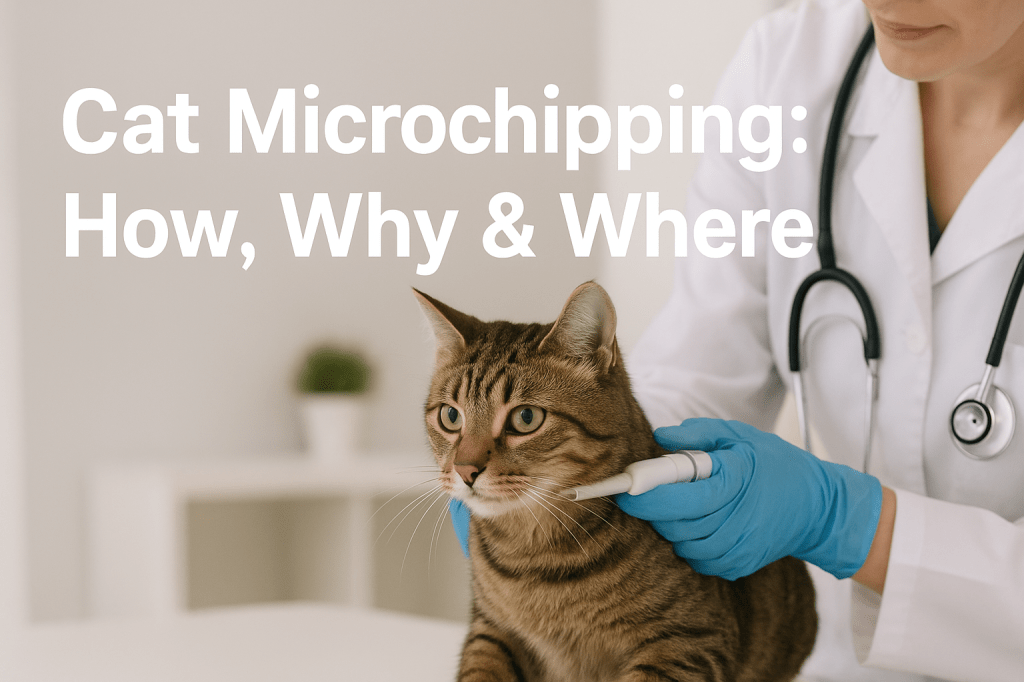
Microchipping your cat is one of the simplest yet most powerful ways to protect their safety and ensure they can always find their way home. Whether your feline is an adventurous outdoor explorer or an indoor cuddle companion, a microchip gives them a permanent digital ID — a lifeline if they ever go missing.
In this article, we’ll cover what microchipping is, how it works, why it’s so important, and where you can get your cat microchipped. We’ll also explain the cost, registration process, aftercare, and the latest laws and best practices in 2025.
🧠 What Is a Microchip for Cats?
A cat microchip is a tiny electronic device — about the size of a grain of rice — implanted under your cat’s skin, usually between the shoulder blades. It contains a unique identification number that’s linked to your contact details in a national database.
Contrary to what some think, a microchip does not track your cat’s location via GPS. Instead, it acts as a digital ID tag that shelters, veterinarians, and animal control officers can scan if your cat is found.
Each microchip has a unique 15-digit number, which corresponds to your cat details — name, phone number, and address — stored securely in an online registry.
⚙️ How Does Cat Microchipping Work?
- Implantation:
The cat veterinarian or trained professional uses a sterile syringe to inject the microchip just under the cat’s skin. It’s a quick, nearly painless process — similar to a vaccination shot. - Registration:
After the chip is implanted, you (or the vet) must register the chip number with your contact information in a pet recovery database. - Scanning:
When a cat is found, animal shelters, rescue centers, or vets use a handheld microchip scanner to detect the chip and access the owner’s contact info. - Reunion:
Once your cat’s ID is retrieved, you’ll be contacted — sometimes within hours — to bring your beloved pet home.
👉 Pro Tip: Always verify that your microchip is registered correctly and update your contact info if you move or change phone numbers.
💡 Why Should You Microchip Your Cat?
Microchipping isn’t just a precaution — it’s often the difference between a lost cat and a reunited family. Here’s why it’s essential:
1. Permanent Identification
Unlike collars or tags that can fall off, microchips stay with your cat for life. It’s a permanent way to prove ownership and identify them instantly.
2. Increases Chances of Recovery
According to the American Veterinary Medical Association (AVMA), microchipped cats are 20 times more likely to be reunited with their owners than those without a chip.
3. Legal Requirements in Many Countries
In 2025, several countries — including the UK, France, and parts of the U.S. and EU — have introduced laws requiring all cats to be microchipped. Failure to comply can result in fines.
4. Proof of Ownership in Disputes
If your cat is stolen or mistaken for a stray, the microchip serves as official proof of ownership.
5. Supports Animal Welfare
Microchipping helps animal shelters and rescue organizations manage stray populations more effectively by quickly reuniting lost cats with their families.
🏥 Where Can You Get Your Cat Microchipped?
You can get your cat microchipped at several places, depending on where you live:
1. Veterinary Clinics
Your local veterinarian is the most common and trusted provider. They ensure the procedure is sterile and safe, and often register the chip on your behalf.
2. Animal Shelters and Rescue Centers
Many shelters include microchipping as part of adoption packages, or offer low-cost microchipping events to the public.
3. Local Councils and Pet Events
Some local authorities or pet charities host free or subsidized microchipping clinics, especially during animal welfare weeks.
4. Pet Stores and Grooming Centers (with certified staff)
In certain regions, trained technicians at pet stores are allowed to perform microchipping — but always confirm their certification and the chip’s registration.
💰 How Much Does It Cost to Microchip a Cat?
The cost of microchipping varies by country, provider, and whether it’s done during another veterinary visit (like neutering). Region Average Cost (2025) Notes USA $25–$50 Often includes registration UK £10–£30 Mandatory for cats over 20 weeks old EU (France, Germany, Spain) €20–€50 Varies by vet clinic Canada CA$35–CA$65 Some shelters offer discounts
Many vets offer bundled packages for kittens that include vaccines, spaying/neutering, and microchipping — saving you money and time.
🧾 Legal Requirements and Microchipping Laws (2025 Update)
🏴 United Kingdom
From June 2024, it became compulsory to microchip all cats over 20 weeks old. Owners face fines up to £500 for non-compliance.
🇫🇷 France
Microchipping (or tattooing) is mandatory for all cats over 7 months old. You must register the chip in the I-CAD (Identification des carnivores domestiques) database.
🇪🇺 European Union
Many EU countries have harmonized laws under the EU Animal Health Regulation, requiring cats to have microchips for travel, ownership, or adoption.
🇺🇸 United States
Laws vary by state. While not mandatory nationwide, microchipping is strongly recommended by organizations like the ASPCA and Humane Society. Some cities, such as Los Angeles, have local ordinances mandating it.
🇨🇦 Canada
Not yet mandatory across provinces, but widely practiced. Microchipping is required for international travel or cat shows.
🧬 What Happens During the Microchipping Procedure?
The microchipping process is quick, simple, and low-risk:
- Preparation:
Your cat is gently restrained, often without anesthesia (though some vets use mild sedation for nervous cats). - Insertion:
Using a sterile syringe, the chip is inserted under the skin between the shoulder blades. - Verification:
The vet scans the area to confirm the chip is functioning. - Registration:
The chip number and your contact details are entered into an official database like Petlog (UK), HomeAgain (USA), or I-CAD (France). - Post-care:
There’s no downtime needed — your cat can resume normal activities immediately.
The entire procedure takes less than five minutes and is safe for cats of all ages (though usually done from 8–12 weeks old).
🧭 How to Register and Update Your Cat’s Microchip
After implantation, registration is the crucial step. Without it, the chip is useless.
Steps to Register:
- Get your microchip number from your vet.
- Visit the national registry website or your chip company’s portal (e.g., Petlog.org.uk , HomeAgain.com ).
- Enter your details — name, phone, address, email.
- Verify ownership via email confirmation.
Keeping Information Updated
Whenever you:
- Move house
- Change phone numbers
- Rehome your cat
You must update your details online. Most registries allow free or low-cost updates.
❓ Can You Tell if a Cat Is Microchipped?
Yes! You can check if your cat has a microchip by:
- Asking your vet to scan your cat.
- Visiting a local shelter for a free scan.
If your cat is already chipped but not registered, you can find out the chip brand from its number (first three digits identify the manufacturer). Then, contact the company to register it properly.
👉 Use online lookup tools like https://www.aaha.org(for U.S. chips) or https://www.i-cad.fr/(France).
🧠 Common Myths About Cat Microchips
Myth Truth “Microchips track cats via GPS.” False — they only store an ID number, not location data. “It hurts the cat.” The procedure is quick and comparable to a vaccination. “Indoor cats don’t need one.” Indoor cats escape more often than expected — thousands go missing yearly. “It can move around the body.” Rarely — chips are designed to stay in place under the skin.
🏡 Indoor vs. Outdoor Cats: Who Needs Microchipping More?
Both do — but for different reasons:
- Outdoor cats are exposed to traffic, weather, and unfamiliar territory, so the chip ensures they can be identified if found far from home.
- Indoor cats, though safer, can still escape through open doors or windows — especially during moves or emergencies.
Even cats living in apartments benefit from microchipping, as accidental escapes happen often.
🧳 Traveling with Your Cat: Microchip Requirements
If you plan to travel internationally, especially within Europe, the UK, or North America, microchipping is mandatory for:
- Pet passports
- Airline approval
- Border entry
Your cat must have an ISO-compliant 15-digit microchip (ISO 11784/11785 standard). Always verify this with your vet before travel.
🧼 Aftercare Tips
Microchipping requires little aftercare, but keep an eye on your cat for 24–48 hours:
- Avoid touching the implant area excessively.
- Watch for mild swelling or tenderness.
- Contact your vet if redness or infection appears (rare).
Once healed, you can ask for periodic scans during annual vet visits to ensure the chip still functions.
🌍 The Future of Cat Identification
By 2025, microchipping technology has advanced significantly. Some new-generation chips now include:
- Temperature sensors for health monitoring.
- QR code-linked profiles for easier recovery.
- Integration with smart collars and pet apps that notify owners when a cat is scanned.
Microchipping continues to evolve — but its purpose remains the same: keeping cats safe and connected to the people who love them.
🔗 Useful External Resources
- https://www.avma.org/
- https://www.humaneworld.org
- https://www.petlog.org.uk/
- https://www.petlink.net
❤️ Final Thoughts
Microchipping your cat is one of the most responsible and loving decisions you can make as a pet owner. It’s quick, affordable, and could be the difference between losing your cat forever and welcoming them back home safely.
So, whether you’ve just adopted a kitten or have an older cat who’s never been chipped — don’t wait. Contact your vet or local shelter today to book a microchipping appointment.
Your cat’s future safety starts with one small chip. 🐾








 Fresh Cat News: Trusted Updates for Cat Lovers & Responsible Owners
Do you found this guide useful, please leave a comment.