Introduction
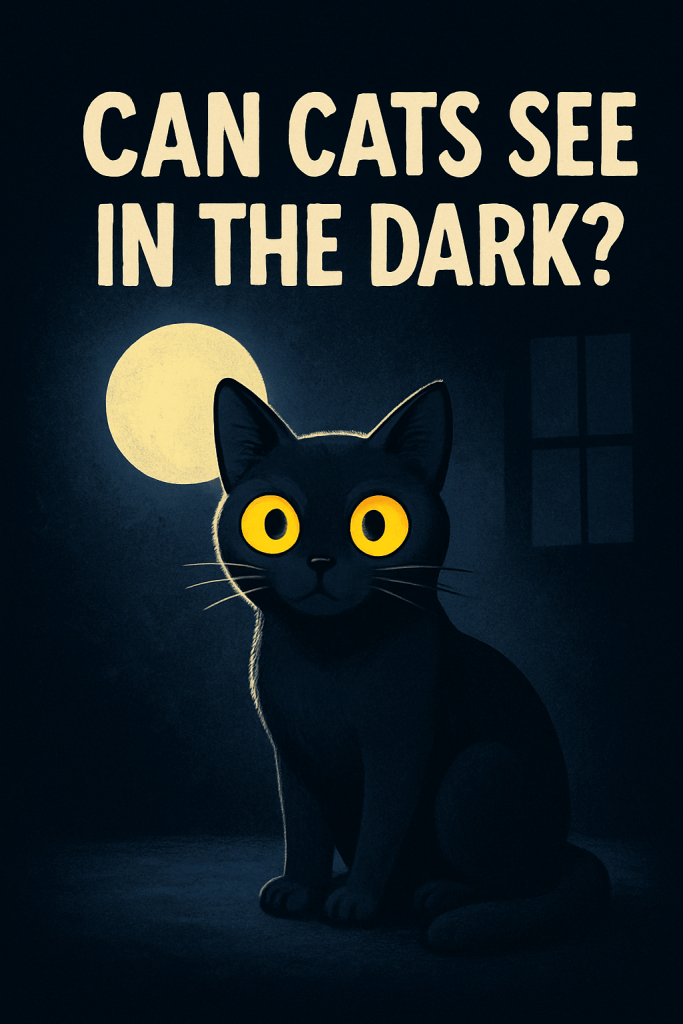
Ever wondered why your cat moves effortlessly through your dimly lit home while you fumble around looking for the switch? And how does that compare to your dog’s nighttime navigation? This post dives into the science behind cats’ superior night vision, comparing it to human capabilities—and even dogs’. We’ll explore eye anatomy, visual mechanisms, and evolutionary adaptations that give cats a nocturnal advantage on the others.
1. The Biological Basis of Night Vision
1.1 Rods vs. Cones: Seeing in Light vs. Darkness
- Rods are photoreceptors optimized for low-light and motion detection.
- Cones handle high-acuity and color perception but need ample light.
- Humans have more cones, making daytime vision sharp and colorful, but night vision poor.
- Cats and dogs possess predominantly rods, optimizing for dim environments .
1.2 Tapetum Lucidum: Nature’s Light Booster
- This reflective layer behind the retina sends unabsorbed light back for a second chance to be detected, boosting sensitivity in low light.
- Cats’ tapetum is denser and more effective—reflecting up to 130× more light than human eyes .
1.3 Pupils and Corneas: Maximizing Light Intake
- Cats have vertically slit pupils that can open extremely wide in dark—far more than human pupils—with pupil area changes exceeding 100×, allowing huge amounts of light to enter .
- Their large corneas and lenses further enhance light capture .
2. How Night Vision Compares: Cats vs. Dogs vs. Humans
2.1 Humans: Limited Night Vision
- Without a tapetum lucidum, humans rely solely on rods, which are fewer in number and less effective—but we win in daylight detail and color fidelity .
2.2 Dogs: Better Than Humans, But Behind Cats
- Dogs also have tapetum lucidum, more rods, and larger pupils than humans—giving them superior night vision compared to us .
- Still, cats outperform dogs under low-light thanks to more rods, a denser reflective layer, and superior pupil control .
2.3 Cats: Champions of Low-Light Vision
- Studies show cats need only about 1/6th the light humans do to see, and can process light six to seven times better than humans .
- Their vertical pupils, abundant rods, and powerful tapetum provide a superlative night-vision setup.
3. Visual Acuity, Color Perception & Field of Vision
3.1 Visual Acuity (Sharpness)
- Cat vision is blurrier—rated roughly 20/100–20/200, meaning what a human sees clearly at 100 feet, a cat sees only at 20 .
- Dogs are similar or slightly better than cats in acuity—but both trail behind humans .
3.2 Color Vision
- Humans enjoy trichromatic vision richly filled with color.
- Dogs are dichromats, seeing mainly blues and yellows; reds and greens appear grayish or brownish .
- Cats similarly see fewer hues—likely blue-violet and greenish-yellow, with limited red/green perception .
3.3 Field of Vision
- Humans: ~180°
- Cats: ~200°—better peripheral vision for hunting
- Dogs: up to ~240°—very wide awareness
4. Why This Matters: Evolutionary and Practical Implications
4.1 Crepuscular and Nocturnal Hunting
- Cats and dogs evolved to hunt during dawn or dusk—times with dim light. Superior low-light vision gave them a survival edge .
4.2 Domestic Benefits
- Your cat’s ability to stealthily move and hunt at night is rooted in those adaptations.
- Dogs may rely more on hearing and smell in the dark, but their low-light vision still serves well .
5. Debunking Common Myths
Myth 1: Cats can see in complete darkness
- Not true. They require at least minimal light—and cannot see in pitch black .
Myth 2: Cats, dogs, and humans see similarly in the dark
- Absolutely not—they have entirely different ocular structures and strengths tailored to different lighting conditions.
Myth 3: Cats see colorless or monochrome in dim light
- In dim light, both cats and humans lose color perception. But cats still outperform us in detecting motion and dark-light contrast.
6. Expert Voices: Highlights from Reddit
“Cats have cones like humans do, but… in daylight their ability to see color and fine detail is far inferior to humans. Their rods… plentiful… and a light-amplifying reflective cell layer… help the cat see… in very little light.”
– reddit user, r/NoStupidQuestions
This observation captures the essence: cats trade fine detail and color for laser-focused low-light advantage.
7. Summary Table
SpeciesLow-Light VisionVisual AcuityColor VisionField of View Humans Poor at night Excellent (~20/20) Full spectrum ~180° Dogs Good (tapetum + rods) Fair (~20/75) Limited (blue/yellow) ~240° Cats Excellent (rods + tapetum) Moderate (~20/100–200) Limited (blue/violet, yellow) ~200°
Conclusion
Yes, cats see much better in the dark than humans—and even better than dogs. Their rod-dominant retinas, vertical pupils, and highly reflective tapetum lucidum give them unparalleled low-light performance in the animal kingdom.
While humans excel in sharp, colorful daylight vision, cats handle nighttime with grace and precision. Dogs are stronger than humans in dim light—but cats still run the show after sundown. Understanding these differences deepens our appreciation for how small, furry nocturnal hunters thrive—whether tracking toys or darting shadows on our walls at midnight.
For more informations on this post, how don’t you visit these links :
https://www.hillspet.com/cat-care/behavior-appearance/can-cats-see-in-the-dark
https://www.animaleyeguys.com/site/blog/2024/01/15/can-cats-see-dark
https://www.tasteofthewildpetfood.com/articles/health/can-cats-see-in-the-dark/







 Fresh Cat News: Trusted Updates for Cat Lovers & Responsible Owners
Do you found this guide useful, please leave a comment.