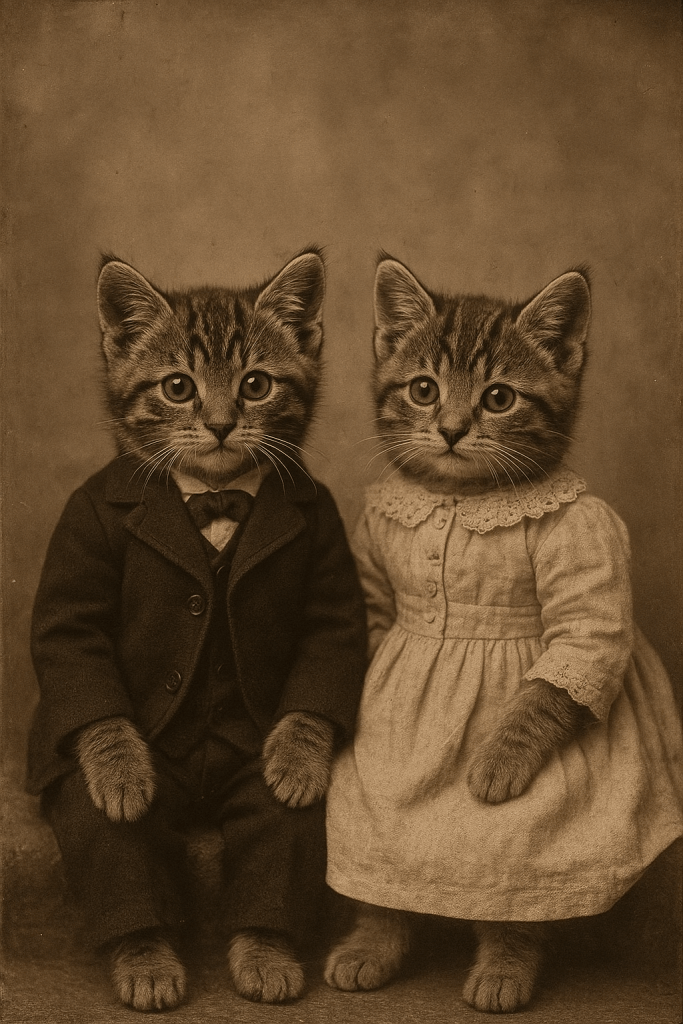
From Crystal Palace cat shows to Brighton’s button-eyed studio stars, Victorian-era cat photographs capture the moment cats stepped from the scullery into the sitting room. Learn how to read the formats (daguerreotypes, tintypes, cartes de visite, cabinet cards), meet the makers, and find, date, and care for these 19th-century treasures—with curated external links to museums and archives.
Why Victorians Started Photographing Cats (and Why It Mattered)
If you’ve ever scrolled past a 19th-century cabinet card of a solemn child gripping a very patient tabby, you’ve glimpsed a quiet revolution. The Victorian era coincided with a surge in pet keeping—especially among the middle classes—along with the first animal-welfare laws and organizations. Britain’s Royal Society for the Prevention of Cruelty to Animals (RSPCA) was founded in 1824 and gained royal patronage under Queen Victoria, reflecting a broader shift toward kindness to animals and the idea of pets as family.
Legal reforms reinforced that shift. The Cruelty to Animals Act of 1835 tightened earlier protections and helped normalize humane treatment, laying a cultural backdrop for sentimental pet portraiture—including photographs—later in the century.
The capstone came in 1871, when artist and organizer Harrison Weir staged the world’s first formal cat show at London’s Crystal Palace. The event helped elevate cats from mousers to pedigreed companions, spawning clubs, standards, and a national conversation about feline beauty—raw material tailor-made for photographs.
Meet the Formats: How Victorians Printed Their Cat Pictures
Understanding the format in your hand (or on your screen) is the fastest way to date a Victorian cat photo and decode the story behind it. Here’s the essential field guide:
Daguerreotype (1840s–mid-1850s)
- Look for: A small, mirror-bright image on a polished silvered copper plate, often in a hinged case.
- Dating tip: Early; exposures could be long, making unruly subjects (read: cats) hard to capture unless asleep or restrained.
- Reference: Excellent primers and galleries from the Library of Congress.
Ambrotype (mid-1850s–1860s)
- Look for: A direct positive on glass, cased like a daguerreotype but with a softer, less mirror-like surface.
- Dating tip: Mid-century transitional format; still studio-bound.
- Reference: Library of Congress overview.
Tintype / Ferrotype (late-1850s–1890s+)
- Look for: An image on a thin iron sheet (magnetic), sometimes in paper mats or simple sleeves.
- Dating tip: Affordable and portable—think fairs and itinerant photographers.
- Reference: Library of Congress guide to the medium.
Carte de Visite (CdV) (mid-1850s–1870s)
- Look for: A small albumen print mounted on card roughly 2.5 × 4 inches, perfect for albums, swapping, and collecting.
- Dating tip: Peak popularity in the 1860s; the go-to for studio pet portraits.
- Reference: Concise background on the carte de visite.
Cabinet Card (1860s–1890s)
- Look for: A larger albumen print (about 4.25 × 6.5 inches) on sturdy card; card colors, corner styles, and decorative backs evolved over time—clues you can use to date mounts.
- Dating tip: By the late 1880s–1890s, elaborate typography and colored cards become more common.
- Reference: Ohio Memory’s historical overview is handy for dating mounts.
Snapshot revolution (late Victorian): In 1888, George Eastman’s Kodak camera—marketed with “You press the button, we do the rest”—kicked off amateur snapshot culture. By 1900, the Brownie made casual pet pictures ubiquitous, a shift you’ll see at the tail end of the Victorian period (and flowing into the Edwardian).
How on Earth Did They Get Cats to Sit Still?
Early photographic exposures were slow, which is why Victorian studios evolved tricks to keep living subjects motionless. For infants, a now-famous solution was the “hidden mother”—a caregiver conceals herself in the frame to steady a child. The same logic (covert support, props, firm hands just out of frame) applied to pets. Recognizing those studio strategies helps explain why some cats look unusually serene or why a suspiciously draped shape lurks near the sitter.
You might also spot chairs with tall backs, imposing tables, or cushions used for a cat to “perch and pose,” plus tightly framed compositions that exclude wriggly paws. Many studio cat portraits show sleepy or supremely calm felines—an exposure-friendly state in an age before fast shutters.
Star of the Show: Harry Pointer and the “Brighton Cats”
No conversation about Victorian cat photos is complete without Harry (sometimes listed as Henry) Pointer (1822–1889), the Brighton photographer who turned cats into celebrities. In the 1870s, Pointer created a wildly popular series known as the “Brighton Cats”—posed studio photographs of cats arranged with props or mid-mischief, often captioned with witty greetings and sold as cartes and later postcards. Customers bought them as novelties, holiday missives, and gifts, making the set an early example of feline virality.
Pointer’s cats balance realism and play. Some images simply show a well-lit tabby on a velvet plinth; others stage little vignettes—cats “posting” letters, “pouring” tea, or “learning” to read. It wasn’t slapstick taxidermy; it was living cats, coaxed into stillness and adorned with just enough prop and caption to spark a chuckle. Surviving examples are scattered across museum collections and the market, often labeled with the studio name plus a punny title.
Why it matters: Pointer proved there was a paying audience for photographs that centered cats not as extras in human portraits but as protagonists—40 years before LOLcats. He also showed how new formats (the CdV and later postcard) could carry a light narrative via captions, a template the Edwardian era would explode with real photo postcards of animals.
“Fancy” Cats in Print and in Person: Harrison Weir, Crystal Palace 1871, and the Rise of Pedigree
Artist-organizer Harrison Weir—nicknamed “the Father of the Cat Fancy”—helped give Victorian Britain a shared vocabulary for feline beauty. He codified standards, founded the National Cat Club in 1887, and, crucially, organized the first cat show at the Crystal Palace in July 1871. Newspapers covered the spectacle; artists illustrated the winners; breeders and householders debated markings and type. Photographers, in turn, capitalized on demand for portraits of prize animals and pets aspiring to that status.
Weir’s own book, Our Cats and All About Them (1889), reads like a snapshot of late-Victorian cat culture: standards, breed lore, advice, and an evangelist’s zeal for the domestic cat as a creature worthy of admiration. You’ll see its influence ripple through late 19th-century pet portraits and even the captions of Brighton cat cards.
Anthropomorphic Tastes: Walter Potter’s Dioramas (and Why They’re Relevant)
Although not photographs, Walter Potter’s Victorian taxidermy tableaux—kittens at a wedding, rabbits at school—are essential context for the era’s cat imagery. The same appetite for humorous, sentimental narratives about animal “society” fueled both Potter’s dioramas and photographic novelties like Pointer’s cards. Potter’s collection, once displayed in Sussex, became a 20th- and 21st-century talking point as it was dispersed and debated, reminding us how Victorians blurred the lines between natural history, entertainment, and sentiment.
From Studios to Sitting Rooms: The Kodak Effect in the 1890s
By the late 1880s, photography slipped the studio leash. Eastman’s Kodak (1888) made it feasible for amateurs to shoot at home; the company even marketed processing as part of the package—“You press the button, we do the rest.” Suddenly, we start to see more informal pet pictures alongside formal cabinet cards. By 1900, the Brownie put box cameras in millions of hands. If you find a casual print of a cat sprawled on a Victorian hearth rug, dated 1898–1901, you’re watching the snapshot era arrive.
How to Read a Victorian Cat Photo Like a Curator
Want to extract the most story from a 19th-century feline portrait? Use this checklist.
1) Identify the format, then bracket the date
Use the guide above to peg your photo to a decade (daguerreotype vs. CdV vs. cabinet card). Mount thickness, card color, corner shape, and studio back designs help fine-tune cabinet cards and cartes into narrower ranges.
2) Study the studio mark
Most CdVs and cabinet cards carry a photographer’s imprint or address. City and street can place the sitter geographically; awards listed on the back can narrow the date (post-medal). A “Brighton” imprint plus a punny caption? You might be holding a Pointer.
3) Scan for stabilizing tricks
Drapes, high-backed chairs, a firm elbow at the crop edge—all signs of strategies used to keep subjects motionless. Traces of the “hidden mother” logic (fabric-covered forms, strategically placed hands) sometimes appear when pets share the frame with infants.
4) Decode breed language with caution
Victorian terms like “Angora” and “Persian” don’t map perfectly onto modern breed standards. Weir’s Our Cats is a period key, but remember that photographic contrast, retouching, and lighting can exaggerate or soften traits.
5) Read the props and captions
Skates, teacups, books, ladders—Pointer’s props telegraph jokes; others reflect household pride (grand pianos, fine rugs). Captions transform a photo into a miniature story, a Victorian meme on albumen paper.
Where to See (and Download) Victorian Cat Photos Today
- National Gallery of Canada: Essays and collection features on pets in Victorian photography (with examples across daguerreotypes, tintypes, and albumen prints).
- The Getty: Collection entries for Henry/Harry Pointer’s “Brighton Cats,” with catalogue details.
- British & European Museums: The National Portrait Gallery’s subject index includes “Pets and animals – Cats,” a rabbit hole worth exploring for late-Victorian and Edwardian imagery.
- Background on formats: Library of Congress pages on daguerreotypes, ambrotypes, and tintypes; Ohio Memory’s primer on cabinet cards.
- The Cat-fancy movement: Britannica’s Harrison Weir entry and the National Cat Club’s origins; also Weir’s own writings and dedicated resources.
Spotlight Stories: Five Victorian Cat Photos to Know
1) The Postcard-Ready Puss (Harry Pointer, Brighton, 1870s)
A neatly posed cat perched on a studio chair, with a minimal prop and a caption like “Just Arrived” or “A Happy New Year.” Pointer’s genius was taking an ordinary pose and giving it a greeting-card voice that made the image giftable—a 19th-century content strategy. Surviving mounts often read “H. Pointer, Brighton” and display the lightly comic caption below the image.
2) The Prize Persian Cabinet Card (Crystal Palace Era, 1870s–1890s)
After 1871, cabinet cards of longhaired show cats proliferate—think wide ruffs, commanding whiskers, and proud owners. Many carry studio imprints near London venues or provincial show circuits, lending geographic clues. The show culture that Harrison Weir helped codify turned the domestic cat into a photographic subject in its own right, not just an accessory to human sitters.
3) The Child-and-Cat Carte de Visite (1860s)
A solemn child gripping a docile cat, both framed by heavy drapery. If you notice a mysterious shape or a supportive adult hand just outside the child’s shoulder, you’re seeing the era’s practical staging to keep small bodies (and paws) still—akin to the hidden mother technique.
4) The Tintype Tabby (1860s–1870s)
Quicker exposures and a cheaper process meant more ordinary families could bring pets before the lens at fairs or itinerant studios. The iron plate gives these images a distinctive, durable feel; surfaces may show bends or light rusting at the edges.
5) The Late-Victorian Snapshot (1890s–1901)
A candid backyard or hearth-rug scene, sometimes slightly soft in focus, signaling a handheld Kodak in amateur hands. These are the forerunners of every casual phone pic of a cat loaf—except made on roll film.
Research Tips: Tracing Photographers, Dates, and Context
- Cross-check the backmark. Studio names and addresses on CdVs/cabinet cards can be searched in city directories, newspapers, and local history sites to narrow dates. Decorative backs also evolved over time; use Ohio Memory’s overview as a starting reference.
- Search the cat-fancy press. Show catalogues and period newspapers often list prize winners (and sometimes portrait commissions). Harrison Weir’s writings help decode period terminology.
- Look for repeatable props. Some studios reused miniature sets—ladders, letterboxes, tiny tea services—especially in novelty cat series. If you find a prop match, you might connect your photo to a known photographer like Pointer.
- Consider cultural echo chambers. Anthropomorphic humor was everywhere from Potter’s dioramas to illustrated magazines. If your cat photo leans theatrical, that’s not an accident—it mirrors broader Victorian tastes.
Caring for Victorian Cat Photos (So They Survive Another Century)
Whether you own a single heirloom CdV or you’re building a small collection of cabinet cards, basic preservation makes a world of difference.
- Handle with clean, dry hands (or nitrile gloves for metal/glass formats). Support mounts with both hands to avoid corner splits.
- Store cool, dry, and dark. Avoid attics and basements; aim for stable temperature and humidity. Archival sleeves or four-flap enclosures prevent abrasion.
- Keep daguerreotypes, ambrotypes, and tintypes in their cases when possible, and never try to “clean” plates—silver and emulsions are fragile.
- Use neutral materials. Acid-free boxes, sleeves, and interleaving reduce chemical damage. The Northeast Document Conservation Center offers practical, illustrated guidance you can follow at home.
Frequently Asked Questions
Were some Victorian cat photos faked or taxidermy?
You’ll meet both living cats (especially in studio series like Pointer’s) and, in other contexts, taxidermy used for tableau or teaching. Potter’s famous dioramas sit in the latter category; they’re not photographs, but they influenced the era’s taste for anthropomorphic animal “stories,” which photographic novelties echoed.
Why do some pet portraits look stiff—or a little spooky?
Slow exposures required stillness. Photographers used props and close framing; with children, the “hidden mother” technique kept things calm. Occasionally you’ll see the unintended trace of a hand or cloaked figure that reveals how the pose was achieved.
How do I tell a late-Victorian photo from an Edwardian one?
Look at the format (cabinet cards decline after the 1890s), the styling of mounts, and the image itself. Casual snapshots rise in the 1890s with Kodak, and by 1900 the Brownie accelerates the shift from formal studio portraits to everyday home scenes.
Where can I see an exhibit specifically about pets in 19th-century photos?
The National Gallery of Canada has produced features and displays focused on pets in Victorian photography; they’re a great jumping-off point for imagery, techniques, and interpretation.
A Short Guide to Collecting Victorian Cat Photos
Start with story. A cabinet card of a cat isn’t just “cute”—it’s a window into an age that codified breeds, reimagined pets as family, and pioneered image formats we still reference. Pointer’s Brighton Cats, show-era portraits inspired by Harrison Weir, and late-Victorian snapshots each tell a distinct chapter.
Mind condition and context. Clean, undamaged mounts and legible backmarks add research value. For metal and glass formats, intact cases and seals matter; consult conservation guidelines before any intervention.
Verify claims. If a seller invokes the Crystal Palace or calls any longhaired cat “a Persian,” cross-check the time frame and terminology against period sources such as Our Cats (1889) and club histories.
Document your finds. Scan both sides, note dimensions, and transcribe any captions. The mount’s typography and even the paper color can aid future dating.
The Bigger Picture: From Parlors to Platforms
Victorian cat photographs sit at the crossroads of technology, taste, and tenderness. They mark the moment domestic cats were publicly celebrated—paraded at Crystal Palace, posed in Brighton studios, cherished in family albums—and they reveal how new tools changed what (and who) could be pictured. When Kodak put a camera in the parlor, cats followed, stretching from velvet-draped studios to everyday firesides, and ultimately into the endless scroll of the 21st century.
If you’re building a feline photo collection—or just getting lost in museum databases—you’re participating in a 150-year-old tradition: finding meaning (and a little mischief) in the way cats occupy our lives and lenses.
Handy External Links (curated)
- https://www.rspca.org.uk/whatwedo/whoweare/history
- https://en.m.wikipedia.org/wiki/Cruelty_to_Animals_Act_1835
- https://harrisonweir.com/cat-shows/
- https://cat-o-pedia.org/clubs.html
- https://www.photohistory-sussex.co.uk/BTNPointerHenry01.htm
- https://www.gallery.ca/magazine/exhibitions/ngc/part-of-the-family-pets-in-victorian-portraits
- https://www.acs.org/education/whatischemistry/landmarks/eastman-kodak.html
- https://www.nedcc.org/free-resources/preservation-leaflets/5.-photographs/5.3-care-of-photographs
- https://www.friendsofdalnavert.ca/blog/2020/7/12/victorian-taxidermy-and-the-peculiar-life-of-walter-potter




 Fresh Cat News: Trusted Updates for Cat Lovers & Responsible Owners
Do you found this guide useful, please leave a comment.