Introduction
The United Kingdom is a land steeped in myth, mystery, and ancient superstition—and among its most enduring figures in folklore are cats. Whether feared as witches’ familiars, admired as shipboard guardians, or memorialized in poetry and local tales, cats in British folklore have captured imaginations for centuries.
In this comprehensive exploration of famous cats in UK folklore, we uncover stories of spectral felines, legendary guardians, magical beasts, and true-life cats who have taken on folkloric status. These cats aren’t just companions—they’re characters in the nation’s long and mysterious narrative.
1. 🐱 The Church Grim – The Guardian Spirit Cat
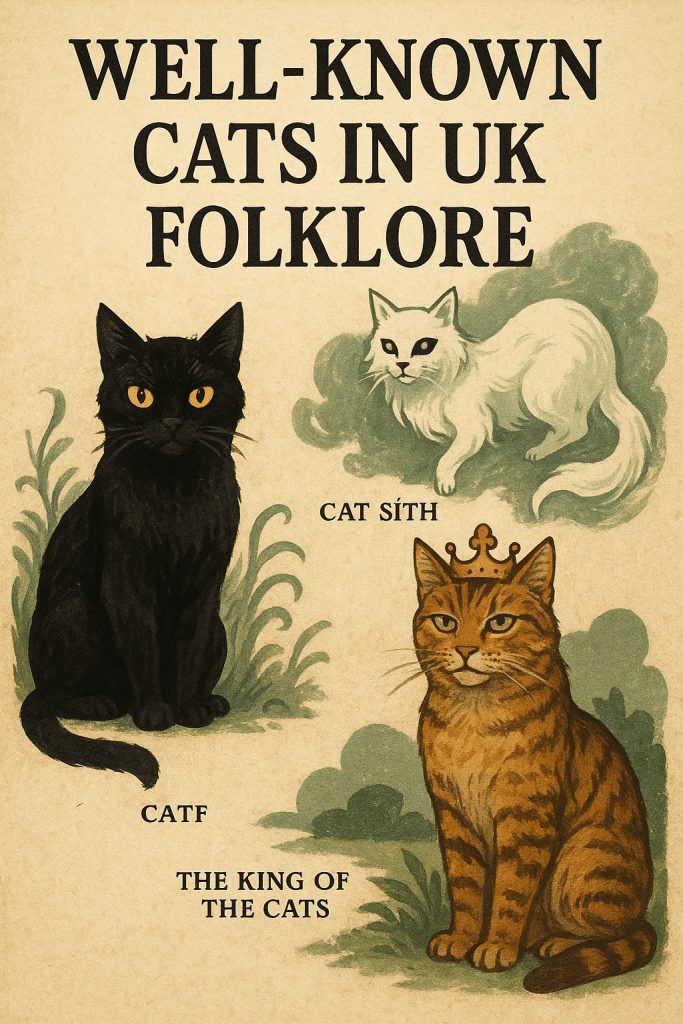
One of the most haunting figures in British folklore is the Church Grim, a supernatural black dog or cat believed to guard churchyards and cemeteries.
Origins and Beliefs
In some rural British communities, it was customary to bury a black cat alive beneath a church foundation stone, believing its spirit would become the church’s eternal guardian. The resulting ghost cat—known as the Church Grim—would protect the grounds from thieves, witches, and evil spirits.
Sightings and Legends
- Seen as a large, shadowy feline figure
- Appears near graves or on the church roof
- Protects the dead and rings ghostly bells before funerals
This legend reflects the dual symbolism of cats in British lore: both protectors and portents of death.
2. 🐾 The Lucky Black Cat of the British Isles
In many parts of the world, black cats are associated with misfortune. But in British folklore, black cats have long been considered symbols of luck, especially in the north of England and Scotland.
Folkloric Roots
Sailors believed that a black cat on board ensured a safe journey. A black cat crossing your path in Britain was seen not as a curse, but as a blessing—a sign of good things to come.
Cultural Superstitions
- Newlyweds were given black cats to ensure a happy marriage
- Fishermen’s wives kept black cats at home to bring their husbands good luck at sea
- A stray black cat choosing your home was considered an immense honor
Black cats were even kept as mascots in shops and pubs—symbols of prosperity and success.
3. ⚓ Ship Cats of the Royal Navy
Cats have played an important role in British naval tradition. They were not only mousers but also revered figures in maritime folklore.
The Mythical Cat of HMS Victory
One of the most famous tales comes from HMS Victory, Admiral Nelson’s flagship at the Battle of Trafalgar. According to myth, a cat was seen fleeing the ship just before battle, which some took as a sign of imminent death—but others believed it protected the souls of fallen sailors.
Famous Naval Cats
- Blackie, Winston Churchill’s ship cat, became famous for his dignified pose as Churchill boarded HMS Prince of Wales to meet Roosevelt in 1941.
- Convoy Cats, a term used during WWII, referred to cats aboard merchant vessels—credited with saving food supplies from rats and offering sailors emotional support during U-boat threats.
4. 🪄 Cats and Witches: Familiars and Fear
Few images are as iconic as a witch with a black cat, and this association was cemented in Britain during the witch trials of the 16th and 17th centuries.
Familiars in Witch Trials
During the English witch hunts, many women were accused of keeping “familiars”—animal spirits or demons that helped them with magic. Cats, particularly black ones, were thought to suckle from “witch’s teats” and spy for their masters.
Notorious Cases
- Mother Shipton, a legendary Yorkshire prophetess, was rumored to have owned a black cat that could predict disasters.
- In Scotland, the 1590 North Berwick witch trials accused several women of sending cats to sea in baskets to cause storms and sink the king’s ship.
These associations fueled centuries of fear and cat-killing, which ironically may have helped spread the plague by allowing rodent populations to flourish.
5. 🧙♀️ The Cat Sìth – The Fairy Cat of Scotland
In Scottish Highlands folklore, the Cat Sìth (pronounced cat shee) is a legendary fairy creature said to resemble a large black cat with a white spot on its chest.
Mysterious Origins
Some believe the Cat Sìth is:
- A witch in disguise, taking feline form nine times before becoming permanently a cat (possibly the origin of “cats have nine lives”)
- A spectral beast who prowls during Samhain (Halloween), stealing souls before burial
Rituals and Protection
- During funerals, the family would watch the corpse constantly to prevent the Cat Sìth from stealing the soul.
- In rural areas, milk offerings were left out for the creature to win its favor.
The Cat Sìth is a powerful symbol of mystery, magic, and death in Highland mythology.
6. 🏚️ The Barn Cat of Bodmin Moor
The Beast of Bodmin Moor is a British cryptid said to roam Cornwall—but many local legends describe it as a giant spectral cat living in old barns and fields.
Characteristics
- Black or dark brown, panther-like in size
- Glowing yellow eyes
- Said to vanish into thin air or leave no prints in the snow
Local Testimonies
- Farmers claim to have seen it stalking sheep
- Some believe it’s a ghost cat, the spirit of a witch’s familiar that was never laid to rest
- Others think it’s the descendant of escaped exotic pets, now folklore
Though debated as real or myth, the Beast of Bodmin remains one of the UK’s most enduring feline legends.
7. 🪦 The Ghost Cat of Athelhampton House
Athelhampton House, a Tudor mansion in Dorset, is home to one of Britain’s most famous ghost cats.
Haunting Activity
- Visitors report feeling a small, cold body rubbing against their leg—only to find no animal nearby.
- The ghost is believed to be the spirit of a beloved pet who died centuries ago.
- Paranormal investigators have captured unexplained meows and pawprints.
The ghost cat has become a beloved resident and part of Athelhampton’s attraction—an example of how feline spirits are more cherished than feared in modern times.
8. 🐾 Dick Whittington’s Cat
Perhaps the most enduring British cat legend is the story of Dick Whittington and His Cat—a tale told to children for generations.
The Folk Story
- A poor boy, Dick, travels to London seeking fortune.
- He owns only a clever cat, who catches rats and mice.
- The cat’s talents help him gain wealth, and he eventually becomes Lord Mayor of London.
Though based on a real historical figure—Richard Whittington, a 14th-century merchant—the cat part of the story is likely folklore, symbolizing loyalty, cleverness, and luck.
Cultural Legacy
- A statue of Dick Whittington and his cat sits in London
- It’s a common pantomime play around Christmas
- The tale is often used to inspire hope and perseverance
9. 📜 The Cat of King Arthur’s Legend
Though not as prominent as dragons or swords, cats do appear in Arthurian myth.
The Great Cat of Anglesey
A tale from Welsh Arthurian lore tells of Cath Palug, a gigantic cat monster said to live on the Isle of Anglesey.
The Legend
- The cat grew from a kitten given to a prince by a fairy
- It became a beast that terrorized the land
- Eventually slain by Sir Kay, one of King Arthur’s knights
Cath Palug is among the oldest mythological cats in the British Isles—blurring the lines between fairy tale and legend.
10. 🪙 Cats in British Coins and Heraldry
While not strictly folklore, cats have made appearances in British currency and symbols, reinforcing their legendary status.
The Isle of Man Cat Coins
The Isle of Man, famous for its tailless Manx cats, issued coins featuring cats throughout the 1980s and 1990s. These coins:
- Celebrated cat breeds
- Honored the symbolic nature of cats in local culture
- Became collectibles around the world
Cats are also found in family crests and heraldry, often symbolizing:
- Independence
- Cunning
- Domestic loyalty
11. 🕯️ Cats in Modern UK Urban Legends
In recent decades, new cat legends have emerged across the UK, blending folklore with urban myth.
The Phantom Big Cats
Across Britain, from Wales to Yorkshire, residents report seeing large black cats—too big to be domestic, yet too fleeting to be captured. Known as ABCs (Alien Big Cats), they’ve been blamed for:
- Livestock killings
- Scaring hikers
- Causing mysterious pawprints
While skeptics claim escaped pets or misidentified dogs, others see it as a continuation of ancient cat beast legends.
Conclusion
From ancient myth to modern mystery, cats have always prowled the edges of British folklore, slipping between the worlds of the living and the spiritual. They’ve been guardians, monsters, companions to royalty and witches, and symbols of both death and fortune.
These legendary cats are not just tales—they are reflections of how Britain sees mystery, independence, and the thin veil between the mundane and the magical. Whether guarding a tomb, haunting a church, or bringing luck to a ship at sea, the cat remains a powerful symbol in the UK’s folkloric tradition.
So next time a cat stares at you from a shadowy corner of a British alley, you may be staring back at centuries of myth.



 Fresh Cat News: Trusted Updates for Cat Lovers & Responsible Owners
Do you found this guide useful, please leave a comment.