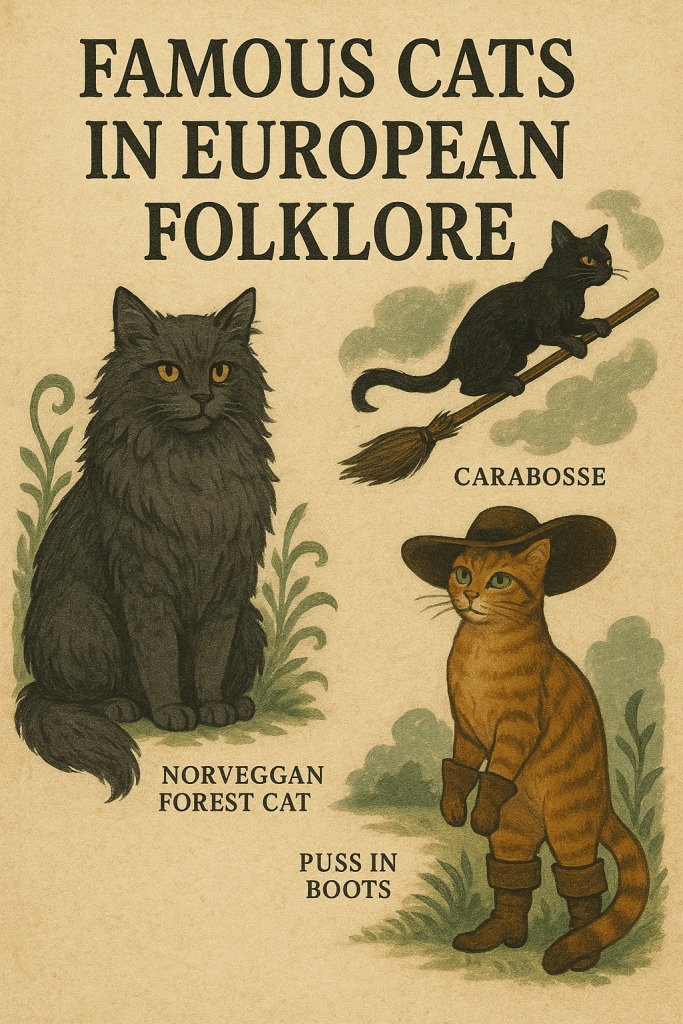
Cats have held a mysterious place in the human imagination for thousands of years, and nowhere is this more evident than in the diverse folklore of Europe. From shape-shifting felines to royal companions, these tales reflect humanity’s enduring fascination with cats—as symbols of power, protectors of the home, or omens of the supernatural. In this article, we journey through Europe to discover the most famous cats in regional legends, fairy tales, and traditional beliefs.
🏰 1. The King of Cats – Celtic Legend (Ireland & Scotland)
One of the most well-known feline legends in Celtic folklore is the story of the King of Cats (also known as Cat Sìth or Cait Sidhe in Scottish Gaelic). These magical creatures were believed to be supernatural black cats with a white spot on the chest, often associated with the otherworld or fairy realm.
The Legend:
A traveler in Ireland once witnessed a group of cats mourning the death of their king. When he returned home and told the tale, his own cat cried out, “Then I am the King of the Cats now!” before vanishing up the chimney, never to be seen again.
Symbolism:
- Regarded as guardians of the spirit world
- Associated with fairies, death rituals, and omens
- Believed to steal souls if left near corpses before burial
🔥 2. Cat Sìth – Scottish Highland Myth
A cousin to the King of Cats, the Cat Sìth is a faerie creature in Scottish Highlands folklore. Said to resemble a large black cat with glowing eyes, it roamed the Highlands, often feared and revered.
Traits and Folklore:
- Believed to steal the soul of the dead if they weren’t buried in time
- On Samhain (Halloween), people left milk offerings outside to appease the Cat Sìth
- Some legends say the Cat Sìth was a witch in disguise with the ability to transform nine times
The myth likely reinforced the practice of watching over the dead to prevent misfortune.
🇳🇴 3. The Norse Forest Cat – Scandinavia (Norway & Sweden)
The Skogkatt (Norwegian for “forest cat”) appears in Norse mythology as a giant, powerful feline. It was said that even Thor, the god of thunder, could not lift the creature.
Connection to the Goddess Freyja:
- Freyja, goddess of love, fertility, and war, traveled in a chariot pulled by two massive cats
- These cats were believed to be sacred and brought good fortune to farmers and lovers
- Cats were often given as wedding gifts in her honor
The modern Norwegian Forest Cat, a real breed, is often romantically linked to this legend.
👑 4. Puss in Boots – France & Europe-wide Fairy Tale
The tale of “Puss in Boots” (Le Maître Chat ou le Chat Botté) is one of the most iconic cat legends in Western Europe, originating in 17th-century France.
Storyline Summary:
A clever cat inherits a pair of boots and uses wit, deception, and charm to transform his poor master into a nobleman—eventually helping him marry a princess.
Key Themes:
- Cunning and strategy over brute strength
- Social mobility through intelligence
- The anthropomorphic cat as a protector and guide
This tale was popularized by Charles Perrault and has since spread through Europe and around the world.
🔮 5. The Witches’ Cats – England and Western Europe
During the Middle Ages and Renaissance, cats—particularly black ones—were believed to be witches’ familiars throughout the UK, Germany, France, and other parts of Europe.
Historical Beliefs:
- Cats were thought to possess supernatural insight
- They were believed to help witches cast spells, spy, or even transform into cats
- Owning a cat could result in accusations of witchcraft
Many of these superstitions contributed to the persecution of women and the mass killing of cats during plague outbreaks, mistakenly blaming them for illness.
🧙 6. Dick Whittington’s Cat – England
A popular English legend tells of Dick Whittington, a poor boy who traveled to London with his cat and later became Lord Mayor three times.
Tale Summary:
- Dick’s cat was an expert mouser
- He sold the cat to a foreign king who was plagued by rats, and earned a fortune
- This allowed him to become a wealthy and respected figure
Cultural Impact:
- A classic morality tale: honesty, hard work, and good fortune
- Whittington’s cat is honored in statues, plays, and nursery rhymes
⚔️ 7. The Cat of Saint Martial – Limousin, France
In this tale from Limousin, France, a sacred cat was said to reside near the tomb of Saint Martial. The cat was associated with miracles and protection of the religious site.
Pilgrims believed:
- The cat could heal ailments
- Harming the cat would lead to divine punishment
- The cat represented the saint’s spirit guardian
🧵 8. The Spinning Cat – German Folklore
In certain parts of Germany, tales were told of a magical spinning cat who would appear to help women complete difficult weaving tasks.
Folklore Notes:
- The cat spun gold thread overnight
- Was often seen as a spirit of the home
- Sometimes considered a trickster if disrespected
Cats in these tales represent both domestic harmony and mystical intervention.
⛪ 9. The Cathedral Cat – Europe-Wide Monastic Traditions
In medieval monasteries across Europe—especially in Italy, Spain, and France—cats were revered not only for controlling mice but also as spiritual companions.
Stories Include:
- Cats that saved sacred manuscripts from rats
- Tales of cats curling up on the laps of monks during prayer
- Some believed cats could sense spiritual purity
The famous painting of a cat in a scriptorium at the Monastery of Saint Gall in Switzerland depicts their cultural place in religious life.
🐉 10. The Cat of Kringa – Croatia
In Eastern European tales, particularly from Kringa, Croatia, there’s a lesser-known but eerie legend of a shape-shifting cat associated with vampiric creatures called kudlak.
Folklore:
- The cat was said to transform at night and roam with spirits
- Killing such a cat required rituals, or else a curse would follow
- Farmers used garlic and herbs to repel it
🐈 11. Black Cats and Luck – Superstitions Across Europe
Beliefs about black cats differ greatly throughout Europe: Country Belief about Black Cats England Good luck if one crosses your path Germany Bad luck if crossing from left to right Italy Omen of death in some regions France Magical and lucky if treated well Russia Associated with mystery and protection
These variations show how deeply rooted and culturally specific cat legends are across Europe.
🎨 12. Cats in European Art and Heraldry
Cats appear in medieval European tapestries, coats of arms, and literature:
- Coat of Arms: Some noble families used cats as symbols of watchfulness and stealth
- Medieval Paintings: Cats often appear beside women, symbolizing independence or fertility
- Poetry & Literature: From Chaucer to Baudelaire, cats are frequent muses
🌍 Final Thoughts: Cats as Mythic Mirrors
Cats in European folklore are more than pets or pests. They are:
- Spiritual guardians
- Witch’s allies
- Royal counselors
- Tricksters and wise creatures
Across borders and centuries, they reflect our hopes, fears, and cultural values—living on in legends, statues, and the ever-present mystery behind their eyes.
📚 Suggested Reading:
- “The Great Cat: Poems About Cats” by Emily Fragos
- “Cats in Art” by Stefano Zuffi
- “Cat World: A Feline Encyclopedia” by Desmond Morris







 Fresh Cat News: Trusted Updates for Cat Lovers & Responsible Owners
Do you found this guide useful, please leave a comment.