Introduction
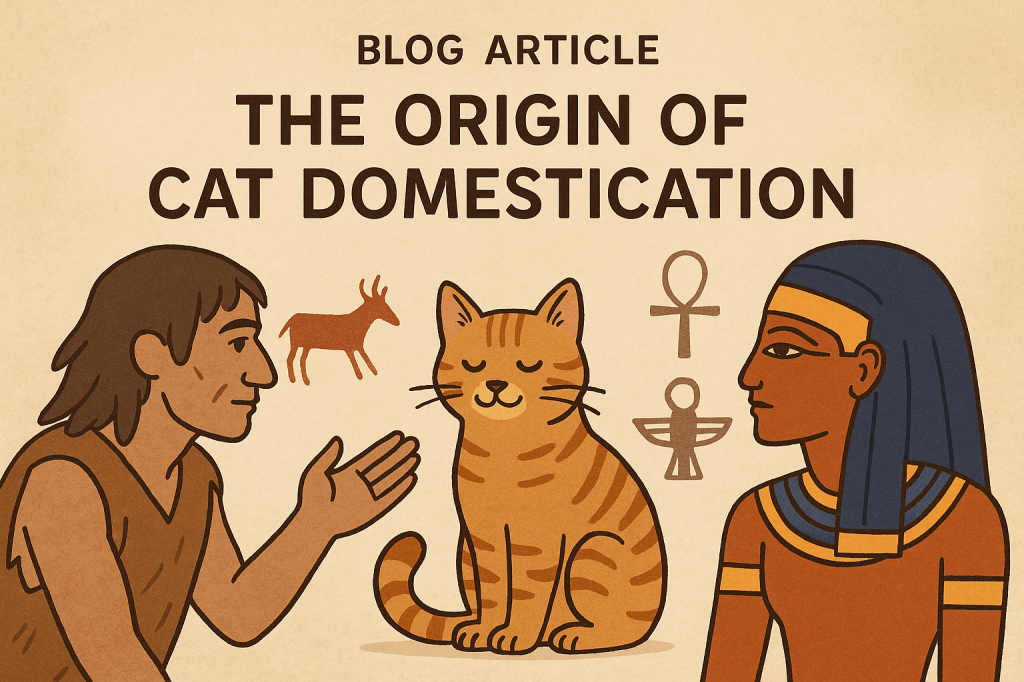
Cats have captivated human beings for millennia with their elegance, mystery, and aloof charm. From sacred animals in ancient temples to modern-day internet celebrities, domestic cats (Felis catus) have journeyed through history in a fascinating way. But where did this journey begin? What was the first true cat? Who was the first human to adopt a feline? And how did the first domestic cat emerge from its wild ancestors?
In this long-form article, we explore the tangled roots of cat domestication, combining archaeological findings, genetic studies, and ancient cultural records. This is the story of how the cat chose humanity—and how humanity, in turn, embraced the cat.
1: The First True Cat — Origins of Felidae
Before domestic cats graced our living rooms, they had a long evolutionary lineage. The Felidae family, which includes all modern cats, likely emerged around 10 to 15 million years ago. The earliest ancestor that can be recognized as a true member of this family is proailurus, which lived about 25 million years ago in Eurasia.
But the first true “cat” resembling modern felines is generally thought to be pseudaelurus, a carnivorous predator that thrived about 9 million years ago and gave rise to several modern lineages of cats. Through millions of years, various evolutionary branches gave birth to the wildcats we know today, including leopards, lions, tigers—and the small but important African wildcat (Felis lybica), the direct ancestor of the house cat.
2: From Wild to Tame — The First Steps Toward Domestication
Unlike dogs, whose domestication was an active process involving selective breeding by early humans, cats appear to have domesticated themselves. This process began around 9,000 years ago in the Fertile Crescent—a region that includes parts of modern-day Turkey, Iraq, Syria, and Egypt—where agriculture first took root.
As early human settlements stored grains, they attracted rodents, which in turn lured wildcats. These small wildcats—particularly felis lybica—found the abundance of food irresistible. Some grew accustomed to human presence. The friendliest and least aggressive of these were tolerated by humans, and over generations, a symbiotic relationship formed. This mutual tolerance marked the birth of cat domestication.
3: The First Adopted Cat — A Burial in Cyprus
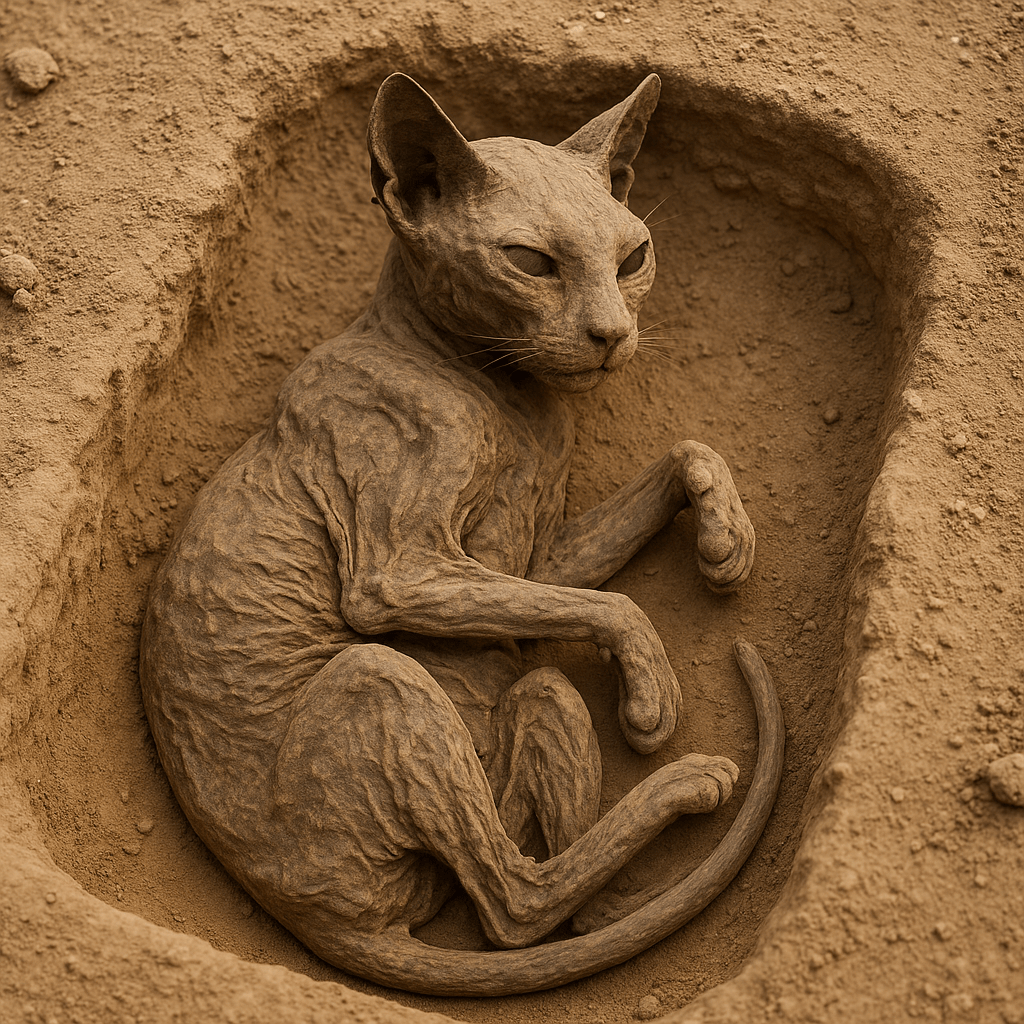
While the process of domestication was gradual, the earliest archaeological evidence of a human-cat relationship comes from the Mediterranean island of Cyprus.
In 2004, researchers discovered a 9,500-year-old grave containing the skeletons of a human and a cat buried together. This Neolithic grave, found in Shillourokambos, predates Egyptian cat worship by several millennia. The cat had been carefully placed alongside the human, suggesting a close bond—not merely a casual cohabitation.
This discovery is often cited as the oldest known evidence of a cat being deliberately kept or “adopted” by a human. Though we cannot know the cat’s name or personality, it stands as the earliest known companion cat, possibly the world’s first adopted feline.
4: Who First Adopted a Cat? A Mystery of Human Affection
So, who was the first person to adopt a cat? The answer remains elusive, lost in the fog of prehistory. Yet the burial in Cyprus offers clues.
The human buried beside the cat was an adult, possibly a male, interred with various grave goods that suggest high social status. That this individual was buried with a cat indicates a bond strong enough to transcend death—a spiritual or emotional connection that still resonates today.
It may have been this early adopter who first recognized the cat not just as a pest controller, but as a companion. If not the first, they were among the first humans to cross the emotional threshold from utility to affection.
5: Ancient Egypt — When Cats Became Divine
Fast forward to 4,000 years ago, and we see the cat’s status rise dramatically in Ancient Egypt. Egyptians not only domesticated cats more extensively, but elevated them to divine status. The goddess Bastet, often depicted as a lioness or a woman with the head of a domestic cat, symbolized protection, fertility, and motherhood.
Egyptians were so fond of their cats that harming one—even accidentally—was a capital crime. Some families mummified their cats and buried them in tombs, ensuring their beloved companions would join them in the afterlife.
This reverence did not emerge in isolation. Egyptian society had likely developed strong emotional bonds with cats through centuries of cohabitation. By this time, cats were integral to family life and spirituality.
6: The Spread of Domestic Cats — From Egypt to the World
From Egypt, cats began to travel.
- Phoenician traders brought them across the Mediterranean.
- Romans adopted them as pest controllers and house pets.
- Vikings likely kept cats aboard ships to control vermin.
- In Asia, cats were welcomed into Buddhist temples as guardians of sacred manuscripts from rodent damage.
By 500 CE, domestic cats had reached China and India. By 1000 CE, they were widespread across Europe, the Middle East, and parts of Asia. Cats adapted to different cultures and climates, always serving dual roles: functional (controlling pests) and emotional (companionship).
7: Medieval Europe — Love and Persecution
In Medieval Europe, the cat’s reputation became complicated. On one hand, many households relied on them to protect food stores. On the other hand, cats were increasingly linked to witchcraft and heresy, particularly black cats.
Despite bouts of mass persecution, cats survived through the Middle Ages, often protected by farmers who valued their utility. They also appeared in art, literature, and folk tales, reflecting their enduring presence in European society.
8: The First Domestic Cat Breeds
The idea of cat “breeds” is a relatively modern concept. While cats had diversified naturally over the centuries due to geographical isolation and climate adaptation, intentional breeding began only in the 19th century.
- The Persian and Siamese were among the first formal breeds recognized.
- The British Shorthair became popular in Victorian England.
- In the U.S., the Maine Coon is considered one of the oldest natural breeds.
These breeds descend from the same ancestor: the African wildcat. Despite differences in appearance, behavior, and size, all domestic cats share the same ancient origin.
9: Genetic Insights — Tracing the Cat’s Family Tree
Recent genetic studies confirm that today’s domestic cats (Felis catus) are virtually indistinguishable from Felis lybica at the DNA level. Domestication has not drastically altered the cat’s physical or behavioral traits, unlike with dogs.
Cats retain strong instincts for hunting and territoriality. Unlike dogs, who evolved to work in teams, cats remain largely solitary. This is why the process of adoption—of cats choosing humans and vice versa—is so fascinating and nuanced.
Modern genetic mapping also suggests that there were at least two independent domestication events: one in the Near East (Fertile Crescent) and another in Egypt. Over time, these lineages blended as cats were traded and transported around the world.
10: The Modern Cat — Adoption in the 21st Century
Today, adopting a cat is as easy as visiting a shelter or logging into an app. But the emotional process—of seeing a cat, forming a bond, and choosing to share your life with them—remains timeless.
Interestingly, the act of adoption is still often initiated by the cat. How many stories begin with “the cat just appeared one day”? Or, “she chose me”? In this way, modern adoption echoes that 9,500-year-old burial in Cyprus.
From the hunter in Mesopotamia to the monk in China, from the pharaoh’s daughter to the modern Instagram cat mom—the desire to bond with a feline friend transcends culture and time.
Conclusion: Why the First Adopted Cat Still Matters
The story of the first adopted cat isn’t just about archaeological finds or genetic data. It’s about connection—between two very different species who found common ground.
That first cat, resting beside a human in a Neolithic grave, symbolized more than companionship. It marked the beginning of an extraordinary partnership that continues today.
So, when you curl up with your cat, remember: you are part of an ancient story. A story that began in the wild and lives on in every purr, every blink, every quiet moment you share. The cat may have chosen to stay close for food at first—but it stayed for something far more profound.
Please, If you have liked this article, share it or leave your opinion . 🙏




 Fresh Cat News: Trusted Updates for Cat Lovers & Responsible Owners
Do you found this guide useful, please leave a comment.